Summary
In her article "Tllili Tlapalli: The Path of the Red and Black Ink" the Gloria Andzaldua talks about what writing means to her. She says that her writing is her "blood sacrifice" (225) and that writing heals her and "brings her great joy" (222)
Synthesis
This article is similar to the other articles that we have recently read about identity. Cixous and Alexander write about what influence gender has on writing, while Smitherman and Delpit discuss the differences between "white and colored rhetorics" and how race influences writing styles. So, all of these articles talk about identity in some way, and how all these different identities make each author's writing original.
My Response
I really liked this article, mostly because it was easy to read and I could relate to it more than I could most of the others that we have read. I could really see who she is coming through in the piece, so she really practices what she writes about in this piece.
AE
1. Anzaldua explains western art to be viewed, while she describes tribal art as being more personal. I think that current literacy and art culture is becoming more communal, particularly in the media because in today's world everyone is connected somehow, so art that is put out there today is seen by large masses of people, even though the artist and the art still have their personal connection despite this.
2. No I do not think that it would have been more effective if it were in a academic format, at least for me anyway. I felt like I could actually understand this piece, and like I actually got something out of it, rather than when I read those articles that are in an academic format, I often think to myself, "what did I just read?"
Thursday, November 29, 2012

Sunday, November 25, 2012
Reading response #23
Summary
In her article " Viewpoint The Laugh of Medusa", Helene Cixous says that women need to use their own voice in their writing, not the voice of others. Cixous says that if women do this it will help them discover who they truly are without men holding them back, and that men dominate the writing industry, making it hard for women to write with their own voice.
Synthesis
This article relates to Flynn because the both discuss the lines that are present between men and women in the literary community, While Alexander also discusses the subject of gender by describing transgender rhetorics, which relates to when Cixous talked about bisexuality.
My Thoughts
I thought that this article was a bit long, and a little confusing sometimes as well. I thought that it was somewhat interesting, but I can't really say that I agree with her in the fact that men are completely to blame for the women's style of writing.
QD
1.Yes, this did make me a little uncomfortable, because she blamed everything on the male population, and it's not their fault. No I really don't think that she was trying to make her reader uncomfortable, she just spoke her mind and that was her only mission.
2. When Cixous says "write yourself", she means that writing can help you discover who you are and that women should not be afraid to write, and should not feel like they are being held back by men.
In her article " Viewpoint The Laugh of Medusa", Helene Cixous says that women need to use their own voice in their writing, not the voice of others. Cixous says that if women do this it will help them discover who they truly are without men holding them back, and that men dominate the writing industry, making it hard for women to write with their own voice.
Synthesis
This article relates to Flynn because the both discuss the lines that are present between men and women in the literary community, While Alexander also discusses the subject of gender by describing transgender rhetorics, which relates to when Cixous talked about bisexuality.
My Thoughts
I thought that this article was a bit long, and a little confusing sometimes as well. I thought that it was somewhat interesting, but I can't really say that I agree with her in the fact that men are completely to blame for the women's style of writing.
QD
1.Yes, this did make me a little uncomfortable, because she blamed everything on the male population, and it's not their fault. No I really don't think that she was trying to make her reader uncomfortable, she just spoke her mind and that was her only mission.
2. When Cixous says "write yourself", she means that writing can help you discover who you are and that women should not be afraid to write, and should not feel like they are being held back by men.
Sunday, November 18, 2012
Response #22
Summary
In his article " Transgender Rhetorics: (Re)Composing Narratives of the Gendered Body" Jonathan Alexander attempts to tell his audience describes the concept of transgender theories. He does this by referencing different essays about transgender theories to show gender as a social construct.
Synthesis
The first thing that I thought about were the Smitherman and Delpit articles that we just read about the racial minorities, and how that relates to the gender minorities present in this article and how minority cultures in general can influence writing.
My Thoughts
I thought this article was okay, I mean it was an interesting topic to think about I suppose. However, it did seem really long and drawn out, which made me lose some interest in it while I was reading it.
AE#3
According to Alexander, normally gendered students can gain exposure to a new perspective on gender roles and the social norms that come with them, as well as how gender influences politics. Yes I do think that this could possibly hold true for the other minorities that we have discussed in class.
AE#4
When Alexander calls gender a construct he means that gender is an obstacle that is often misinterpreted in our society and that is a matter that is very personal to some, but affects politics for all. This is why it needs to be addressed in classrooms because it is a subject that is relevant in today's society and people need to know about it to understand the issues that are present in relation to it, as well as understand the writing styles that are used in that community.
In his article " Transgender Rhetorics: (Re)Composing Narratives of the Gendered Body" Jonathan Alexander attempts to tell his audience describes the concept of transgender theories. He does this by referencing different essays about transgender theories to show gender as a social construct.
Synthesis
The first thing that I thought about were the Smitherman and Delpit articles that we just read about the racial minorities, and how that relates to the gender minorities present in this article and how minority cultures in general can influence writing.
My Thoughts
I thought this article was okay, I mean it was an interesting topic to think about I suppose. However, it did seem really long and drawn out, which made me lose some interest in it while I was reading it.
AE#3
According to Alexander, normally gendered students can gain exposure to a new perspective on gender roles and the social norms that come with them, as well as how gender influences politics. Yes I do think that this could possibly hold true for the other minorities that we have discussed in class.
AE#4
When Alexander calls gender a construct he means that gender is an obstacle that is often misinterpreted in our society and that is a matter that is very personal to some, but affects politics for all. This is why it needs to be addressed in classrooms because it is a subject that is relevant in today's society and people need to know about it to understand the issues that are present in relation to it, as well as understand the writing styles that are used in that community.
Thursday, November 15, 2012
Response #21
Summary
In her article "God Don't Never Change", Geneva Smitherman attempts to explain to her audience that Black English and White English are simply different styles, and they should not be compared to each other to define grammatical correctness. She explains this by giving examples of writing by black students who received bad grades due to their grammar usage. She believes that trying to teach those used to black English white English is oppressive and racist, as well as destructive to their identity.
Synthesis
This article deals a lot with identity, a lot like Flynn and Delpit. It connects with Delpit especially because both Delpit and Smitherman are both discussing the black vs. white English issue. This connects with Gee because black and white English could both be considered as different Discourses.
My Thoughts
I thought these articles were somewhat interesting. I never really had thought about the grammar differences in this way before, and it was interesting to see how the differences in culture can affect written English.
QD
1. Smitherman is using Black Idiom rhetorically because she uses this language in her article, thus supporting her point that it is a style that can be used in academic writing.
2. Language promotes power for specific races and classes because throughout history, the white people have been the dominant race in the American culture, thus it has become standard to use white English, which is oppressive to other cultures, including black culture.
In her article "God Don't Never Change", Geneva Smitherman attempts to explain to her audience that Black English and White English are simply different styles, and they should not be compared to each other to define grammatical correctness. She explains this by giving examples of writing by black students who received bad grades due to their grammar usage. She believes that trying to teach those used to black English white English is oppressive and racist, as well as destructive to their identity.
Synthesis
This article deals a lot with identity, a lot like Flynn and Delpit. It connects with Delpit especially because both Delpit and Smitherman are both discussing the black vs. white English issue. This connects with Gee because black and white English could both be considered as different Discourses.
My Thoughts
I thought these articles were somewhat interesting. I never really had thought about the grammar differences in this way before, and it was interesting to see how the differences in culture can affect written English.
QD
1. Smitherman is using Black Idiom rhetorically because she uses this language in her article, thus supporting her point that it is a style that can be used in academic writing.
2. Language promotes power for specific races and classes because throughout history, the white people have been the dominant race in the American culture, thus it has become standard to use white English, which is oppressive to other cultures, including black culture.
Tuesday, November 13, 2012
Response #20
Pre Reading
Personally, I haven't really paid too much attention to whether or not teachers treated students differently based on gender, so I honestly haven't noticed. I suppose it depends on the teacher, because now that I think about it, sometimes the teacher tends to sympathize a bit more with those of the same gender as them, but other than that I really don't notice where there is too much discrimination.
Summary
In her article "Composing as a Woman" , Elizabeth Flynn attempts to explain to her audience her argument that in our society most writing has been from the male perspective over the years, and that a women's perspective needs to be included as well.
Synthesis
This article was quite different from the others that we have read, however, it does still connect with he others in the area that identity shapes a person's writing. The difference is while the others were talking about how identity works within a discourse community alone, this one was focused more on the identity of being a woman.
QD
I think that this means that throughout history, society has seen men as being the "authoritative" gender based on stereotypes. This relates to the marginalization of other minorities because in today's society, uniformity is what is valued, especially in the professional world.
My Thoughts
I thought this article was okay, it was an interesting topic to think about. However, the problem with it was that other than the identity thing, I really don't see how it connects to the other articles we have read.
Personally, I haven't really paid too much attention to whether or not teachers treated students differently based on gender, so I honestly haven't noticed. I suppose it depends on the teacher, because now that I think about it, sometimes the teacher tends to sympathize a bit more with those of the same gender as them, but other than that I really don't notice where there is too much discrimination.
Summary
In her article "Composing as a Woman" , Elizabeth Flynn attempts to explain to her audience her argument that in our society most writing has been from the male perspective over the years, and that a women's perspective needs to be included as well.
Synthesis
This article was quite different from the others that we have read, however, it does still connect with he others in the area that identity shapes a person's writing. The difference is while the others were talking about how identity works within a discourse community alone, this one was focused more on the identity of being a woman.
QD
I think that this means that throughout history, society has seen men as being the "authoritative" gender based on stereotypes. This relates to the marginalization of other minorities because in today's society, uniformity is what is valued, especially in the professional world.
My Thoughts
I thought this article was okay, it was an interesting topic to think about. However, the problem with it was that other than the identity thing, I really don't see how it connects to the other articles we have read.
Tuesday, November 6, 2012
Response #19
Summary
In his article "Memoria Is a Friend of Ours: On the Discourses of Color" Victor Villanueva attempts to explain to the reader the concept of memoria, based on the Greek "pathos, logos, and ethos" to describe an author's background and thus their identity as well. He does this by explaining colonial discourse, which describes the differences between race and the difficulties that are associated with it.
Synthesis
This article definitely relates to the discourse community articles that we have been reading. However, it seems like this one goes a little deeper into the subject by pulling the aspect of race into the discourse community as an issue, rather than just explaining what a discourse community is.
Personal Response
I thought this article was interesting in the way that discourse community was applied to a real life situation and not just something that is only spoken about and relevant in a college classroom setting.
QD#7
Villanueva's primary discourse was his personal home life while his second discourse was his professional career life. I think that this makes it seem much more complex than Gee accounted for because Villanueva's discourse had more to do with memories, race and his personal experiences than the concepts set by Gee.
In his article "Memoria Is a Friend of Ours: On the Discourses of Color" Victor Villanueva attempts to explain to the reader the concept of memoria, based on the Greek "pathos, logos, and ethos" to describe an author's background and thus their identity as well. He does this by explaining colonial discourse, which describes the differences between race and the difficulties that are associated with it.
Synthesis
This article definitely relates to the discourse community articles that we have been reading. However, it seems like this one goes a little deeper into the subject by pulling the aspect of race into the discourse community as an issue, rather than just explaining what a discourse community is.
Personal Response
I thought this article was interesting in the way that discourse community was applied to a real life situation and not just something that is only spoken about and relevant in a college classroom setting.
QD#7
Villanueva's primary discourse was his personal home life while his second discourse was his professional career life. I think that this makes it seem much more complex than Gee accounted for because Villanueva's discourse had more to do with memories, race and his personal experiences than the concepts set by Gee.
Sunday, November 4, 2012
Response #18
Summary
In their article " Autism and Rhetoric" Paul Heilker and Melanie Yergeau explain to the reader the concept of autism being a rhetoric. They argue this by explaining how autism is a rhetoric because it is a "focus on communication in social interaction" (262), and thus define it as a "rhetorical phenomenon" (262)
Synthesis
I could't really relate this to too much because it is a completely different topic than anything else that we have read lately because the topic was so different, however it can definitely be related to the discourse community because from the way the authors talk in this article, autism is a discourse community.
My Thoughts
I thought this article was pretty interesting, mostly because I had never thought about autism in this way of it being a community within itself.
In their article " Autism and Rhetoric" Paul Heilker and Melanie Yergeau explain to the reader the concept of autism being a rhetoric. They argue this by explaining how autism is a rhetoric because it is a "focus on communication in social interaction" (262), and thus define it as a "rhetorical phenomenon" (262)
Synthesis
I could't really relate this to too much because it is a completely different topic than anything else that we have read lately because the topic was so different, however it can definitely be related to the discourse community because from the way the authors talk in this article, autism is a discourse community.
My Thoughts
I thought this article was pretty interesting, mostly because I had never thought about autism in this way of it being a community within itself.
Thursday, November 1, 2012
Intro/Conversation draft
The discourse community is a concept today that can be defined in many ways. Some, like Swales, explain this by describing the criteria that the discourse community must follow, while others, like Gee, may describe Discourse as being more of an identity based concept. No matter what the explanation, discourse communities are an example of how writing is not just words on paper but rather how it is a crucial contributor to the social world. Discourse communities show us this because they are groups of people in different groups that are not always just writers or writing scholars, but any group that has a set of rules for communication and methods and has a common set of goals. Some scholars that explain this to us are John Swales, James Paul Gee, Elizabeth Wardle, and Devitt et al. (Amy Devitt, Anis Bawarshi, and Mary Jo Reiff).
Swales approaches the subject of discourse community by explaining the criteria that discourse communities must follow, which he breaks down into six points. These six points are a common set of goals, intercommunication, provide information and feedback, genres, lexis, and various levels of expertise among its members.
Gee approaches discourse community first by giving it a completely different title, by simply calling it a "Discourse" instead. He claims that Discourse is identity based, and that a person can become part of a Discourse by enculturation or apprenticeship. He sums up his claim by stating "You are either in it or you're not" (487), so therefore someone is either fully fluent in the Discourse or they are not, there is no in between.
Wardle takes an identity based approach to discourse communities much like Gee does, however she explains it through the three modes. These three modes of belonging are engagement, imagination, and alignment. Wardle also approaches the subject by discussing the concept of tools and their use in the discourse community.
Devitt et al. takes the approach to discourse community by means of genre analysis. Devitt claims that no matter what the type of community, the genre in which they write is very important in order to understand how that discourse community functions.
In this ethnography I am going to focus on the discourse community of theatre, and how all of these approaches listed above apply to this in order to classify it as a discourse community. In order to do this, I will apply different texts used by those in the theatre community and analyze how they fit into these characteristics, as well as interview individuals involved in various levels of theatre about how they intercommunicate with others in their field, as well as their strategies for doing so.
Mr. Vetter, I feel like this is a bit choppy sounding and that I could maybe go into a little more detail, but I'm not sure where to expand and where to keep it short because I don't really want to sound like I'm rambling or anything. Any suggestions?
Swales approaches the subject of discourse community by explaining the criteria that discourse communities must follow, which he breaks down into six points. These six points are a common set of goals, intercommunication, provide information and feedback, genres, lexis, and various levels of expertise among its members.
Gee approaches discourse community first by giving it a completely different title, by simply calling it a "Discourse" instead. He claims that Discourse is identity based, and that a person can become part of a Discourse by enculturation or apprenticeship. He sums up his claim by stating "You are either in it or you're not" (487), so therefore someone is either fully fluent in the Discourse or they are not, there is no in between.
Wardle takes an identity based approach to discourse communities much like Gee does, however she explains it through the three modes. These three modes of belonging are engagement, imagination, and alignment. Wardle also approaches the subject by discussing the concept of tools and their use in the discourse community.
Devitt et al. takes the approach to discourse community by means of genre analysis. Devitt claims that no matter what the type of community, the genre in which they write is very important in order to understand how that discourse community functions.
In this ethnography I am going to focus on the discourse community of theatre, and how all of these approaches listed above apply to this in order to classify it as a discourse community. In order to do this, I will apply different texts used by those in the theatre community and analyze how they fit into these characteristics, as well as interview individuals involved in various levels of theatre about how they intercommunicate with others in their field, as well as their strategies for doing so.
Mr. Vetter, I feel like this is a bit choppy sounding and that I could maybe go into a little more detail, but I'm not sure where to expand and where to keep it short because I don't really want to sound like I'm rambling or anything. Any suggestions?
Tuesday, October 30, 2012
Wardle response #17
Summary
In her article "Identity, Authority, and Learning to Write in New Workplaces", Elizabeth Wardle attempts to explain to the reader that writing in a new situation in a new discourse community, such as a job, can be very difficult. She argues this by telling a story about "Alan", who has trouble adjusting to the new discourse community that is surrounding him because he assumes that he has more authority than the others in his department.
Synthesis
This article can be compared to all of the other articles that we have read about discourse community. It relates to Gee because Alan certainly was a great example of the either you're in or you're out mentality of the Gee article. While she defines what she believes to be a discourse community like Swales does, she takes a whole new approach to it by using the example of Alan to explain what effects the discourse community can have on a person rather than just explaining them. As part of this new approach, Wardle also introduces the concept of "tools" in discourse communities that none of the other articles talked about.
In her article "Identity, Authority, and Learning to Write in New Workplaces", Elizabeth Wardle attempts to explain to the reader that writing in a new situation in a new discourse community, such as a job, can be very difficult. She argues this by telling a story about "Alan", who has trouble adjusting to the new discourse community that is surrounding him because he assumes that he has more authority than the others in his department.
Synthesis
This article can be compared to all of the other articles that we have read about discourse community. It relates to Gee because Alan certainly was a great example of the either you're in or you're out mentality of the Gee article. While she defines what she believes to be a discourse community like Swales does, she takes a whole new approach to it by using the example of Alan to explain what effects the discourse community can have on a person rather than just explaining them. As part of this new approach, Wardle also introduces the concept of "tools" in discourse communities that none of the other articles talked about.
Sunday, October 28, 2012
Project 3 proposal
For this project, I chose to do an ethnography on the discourse community of theater. This qualifies as a discourse community because in the field of theater, the six characteristics that are mentioned by Swales apply. They have an agreed set of common goals, all which work toward the main goal of a great performance. They also have their methods of communication and terms that are used to commmunicate specifically between those in that community, an example of this being how they describe stage directions, which is a concept that I will explain more in depth in my paper. People get accepted into this discourse community usually by their level of talent or skill, however this level of skill varies, thus creating the "reasonable ratio between novices and experts" as mentioned by Swales. (WAW 473)
I am interested in studying this discourse community because in high school I was involved in my school's theater department and either acted or participated in all of the plays. This is something that still interests me, and the fact that I was active in the drama community at school makes me want to learn even more about the higher levels in that discourse community and what those entail. I would like to find out more about their methods and terms of communication and how these vary between the higher and lower levels of experience within the community. I am curious about how the directors speak to the performers and crew depending on the levels of experience and even how this differs between the different types of plays. I would also like to know about the differences in how performers and crew communicate with each other depending on these same factors. When it comes to writing I would like to find out more about how different kinds of plays are set up and how the way they are written affects the way that a director would set up the stage and the performers. I think that this would be interesting because there are so many different types of plays and levels of experience in this field, yet there are so many things that are the same. Regardless of whether it is a high school play or a Broadway production, there are many of the same elements present in both. There are many differences between those two sub-communities, yet the main goals and many of the communication methods are the same, thus leading me to believe that the field of theater is indeed a discourse community.
Some individuals that I could interview are those who are involved in the school of theater or other drama based clubs on campus. I could also interview some people that are involved in drama in high school and talk about the similarities and differences between the two categories of the community.
Some texts that I could analyze are various scripts and playbills, and possibly some advertisements that are used to promote their plays, which are texts that can be used to further the goals of the group. I could also analyze blogs or discussion boards where people in the field talk about the subject. I could analyze the different scripts (these could be musicals, dialogues, or any other sort of play) by finding the similarities in the terms that are used in each, which can be used as an example that could show how this field is a discourse community.
I am interested in studying this discourse community because in high school I was involved in my school's theater department and either acted or participated in all of the plays. This is something that still interests me, and the fact that I was active in the drama community at school makes me want to learn even more about the higher levels in that discourse community and what those entail. I would like to find out more about their methods and terms of communication and how these vary between the higher and lower levels of experience within the community. I am curious about how the directors speak to the performers and crew depending on the levels of experience and even how this differs between the different types of plays. I would also like to know about the differences in how performers and crew communicate with each other depending on these same factors. When it comes to writing I would like to find out more about how different kinds of plays are set up and how the way they are written affects the way that a director would set up the stage and the performers. I think that this would be interesting because there are so many different types of plays and levels of experience in this field, yet there are so many things that are the same. Regardless of whether it is a high school play or a Broadway production, there are many of the same elements present in both. There are many differences between those two sub-communities, yet the main goals and many of the communication methods are the same, thus leading me to believe that the field of theater is indeed a discourse community.
Some individuals that I could interview are those who are involved in the school of theater or other drama based clubs on campus. I could also interview some people that are involved in drama in high school and talk about the similarities and differences between the two categories of the community.
Some texts that I could analyze are various scripts and playbills, and possibly some advertisements that are used to promote their plays, which are texts that can be used to further the goals of the group. I could also analyze blogs or discussion boards where people in the field talk about the subject. I could analyze the different scripts (these could be musicals, dialogues, or any other sort of play) by finding the similarities in the terms that are used in each, which can be used as an example that could show how this field is a discourse community.
Thursday, October 25, 2012
Devitt responses #16
Summary
In their article "Materiality and Genre in the Study of Discourse Communities", Amy Devitt, Anis Bawarshi, and Mary Jo Reiff attempt to explain to their audience that genre analysis can help students to understand discourse communities. They argue that if students apply this concept to other professions such as law or medicine that they will therefore have a better understanding of what a discourse community entails.
Synthesis
This article is similar to the last two that we have read, those being the Swales and Gee articles. All three are on the topic of discourse communities, and each one takes its own approach to describing what this term means to their readers.
Thoughts
Honestly, I thought this article was really strange. I understand how the concept of discourse community can be applied to all of these different professions, but the way that the three of them explained it in this article was incredibly confusing to me. I don't know if it was the wording, or the style, or what it was, but it was just a really difficult piece to comprehend.
In their article "Materiality and Genre in the Study of Discourse Communities", Amy Devitt, Anis Bawarshi, and Mary Jo Reiff attempt to explain to their audience that genre analysis can help students to understand discourse communities. They argue that if students apply this concept to other professions such as law or medicine that they will therefore have a better understanding of what a discourse community entails.
Synthesis
This article is similar to the last two that we have read, those being the Swales and Gee articles. All three are on the topic of discourse communities, and each one takes its own approach to describing what this term means to their readers.
Thoughts
Honestly, I thought this article was really strange. I understand how the concept of discourse community can be applied to all of these different professions, but the way that the three of them explained it in this article was incredibly confusing to me. I don't know if it was the wording, or the style, or what it was, but it was just a really difficult piece to comprehend.
Tuesday, October 23, 2012
Gee responses #15
Pre-Reading
Its a bit hard to think about the activities that I take part in here at college and how they relate to this, but when I think back to high school, I was involved in band and the drama club. In these activities, we had our different terms and things that we used in each. However, they did influence each other a lot probably because many people that were in band were in drama as well, and vice versa, so there was some bleed over in the language spoken in both activities.
Summary
In his article, "Literacy, Discourse, and Linguistics", James Paul Gee attempts to tell the reader about his thoughts on what discourse communities are about. He argues that you can't fake being in a discourse because they will not accept you into that community if you do.
Synthesis
This article is similar to the Swales article because they are both talking about the same subject of discourse community. In the Swales article, he talks more about the differences between discourse communities, while in this article Gee talks more about the particulars that a discourse entails.
QD#1
Gee means that your grammar can be perfect, but depending on the setting and who you are talking to can make what you are saying seem completely wrong. Yes this does conflict with what I have been taught in school because they tell you to use proper grammar all of the time, regardless of the community that you are speaking to.
My thoughts
I thought this would have been a pretty informative article, but I'm still not sure that I completely understand what he is trying to say. It seems like he is doing nothing but blathering on about random stuff and I don't know, but it just doesn't make much sense.
Its a bit hard to think about the activities that I take part in here at college and how they relate to this, but when I think back to high school, I was involved in band and the drama club. In these activities, we had our different terms and things that we used in each. However, they did influence each other a lot probably because many people that were in band were in drama as well, and vice versa, so there was some bleed over in the language spoken in both activities.
Summary
In his article, "Literacy, Discourse, and Linguistics", James Paul Gee attempts to tell the reader about his thoughts on what discourse communities are about. He argues that you can't fake being in a discourse because they will not accept you into that community if you do.
Synthesis
This article is similar to the Swales article because they are both talking about the same subject of discourse community. In the Swales article, he talks more about the differences between discourse communities, while in this article Gee talks more about the particulars that a discourse entails.
QD#1
Gee means that your grammar can be perfect, but depending on the setting and who you are talking to can make what you are saying seem completely wrong. Yes this does conflict with what I have been taught in school because they tell you to use proper grammar all of the time, regardless of the community that you are speaking to.
My thoughts
I thought this would have been a pretty informative article, but I'm still not sure that I completely understand what he is trying to say. It seems like he is doing nothing but blathering on about random stuff and I don't know, but it just doesn't make much sense.
Sunday, October 21, 2012
Response 14 - Swales
Summary
In his article "The Concept of Discourse Community", John Swales attempts to explain to his readers what a discourse community is. He argues that there are differences between discourse communities and other academic groups because there are speech communities, where people are inherited into the group, while in a discourse community recruits its members.
Synthesis
This article was similar to the other article that we read about discourse community a few weeks ago. I do not remember off the top of my head who wrote that article, but I think that this one by Swales goes a little deeper into the topic than the other one did. I feel like I understand a little more about what a discourse community is now.
Pre-Reading
The time that I think I felt most out of place was when I first came to college here. I felt so different from everyone, and I'll be honest I felt pretty stupid too, everyone seemed so much smarter than me. I grew up in a small farming town that had pretty traditional conservative values. Then, I come here and everyone is so different, most of them from fancy city suburbs with beliefs and lifestyles that to me seem a bit absurd. One time when my friends and I were talking about what we did over the summer, I mentioned that I worked on my Grandpa's farm, and they looked at me like I had twelve eyes or something. I felt really out of place when I first got here.
#5 QD
I suppose I belong to the discourse community of this class, because in the work we do we have a set of goals and you can't just be "inherited" into this class like in a speech community, but instead had to sign up for it and get accepted. Our shared goals are the projects and these responses. The lexis I suppose would be the readings we do and the terms that we talk about there.
My thoughts
I thought this reading was pretty informative, it really did clear up a few things about what a discourse community was. However, some of the terms that he was using in the article are still a bit confusing to me. I didn't really like the article, but I'll be honest, I've read worse.
In his article "The Concept of Discourse Community", John Swales attempts to explain to his readers what a discourse community is. He argues that there are differences between discourse communities and other academic groups because there are speech communities, where people are inherited into the group, while in a discourse community recruits its members.
Synthesis
This article was similar to the other article that we read about discourse community a few weeks ago. I do not remember off the top of my head who wrote that article, but I think that this one by Swales goes a little deeper into the topic than the other one did. I feel like I understand a little more about what a discourse community is now.
Pre-Reading
The time that I think I felt most out of place was when I first came to college here. I felt so different from everyone, and I'll be honest I felt pretty stupid too, everyone seemed so much smarter than me. I grew up in a small farming town that had pretty traditional conservative values. Then, I come here and everyone is so different, most of them from fancy city suburbs with beliefs and lifestyles that to me seem a bit absurd. One time when my friends and I were talking about what we did over the summer, I mentioned that I worked on my Grandpa's farm, and they looked at me like I had twelve eyes or something. I felt really out of place when I first got here.
#5 QD
I suppose I belong to the discourse community of this class, because in the work we do we have a set of goals and you can't just be "inherited" into this class like in a speech community, but instead had to sign up for it and get accepted. Our shared goals are the projects and these responses. The lexis I suppose would be the readings we do and the terms that we talk about there.
My thoughts
I thought this reading was pretty informative, it really did clear up a few things about what a discourse community was. However, some of the terms that he was using in the article are still a bit confusing to me. I didn't really like the article, but I'll be honest, I've read worse.
Sunday, October 7, 2012
Wysocki Response #13
Pre-Reading
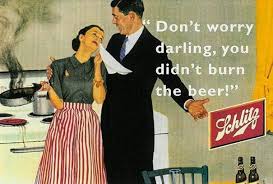 This old advertisement for beer is one that I found that I have mixed feelings about. While it is somewhat humorous and portrays the whole 1950's "everything is pleasant" thing, it also shows the woman to be the inferior servant for her husband, who makes fun of her in the ad. So, even though it is kinda funny, it also angers me a bit.
Summary
In her article "The Sticky Embrace of Beauty", Anne Frances Wysocki attempts to explain to the reader about the way that advertising is pleasing and/or offensive. She argues that the way "beauty" is shown in advertisements may be pleasing to the eye, but the context in which it is being used can be offensive, especially in the way of objectifying women that she talks about in this article.
Synthesis
I honestly can't relate this to much else that we have read, but I do see a similarity between this and the Bernhardt article because both talked about how the visual aspects of a piece of writing (or in this case advertisements) have an effect on the reader.
QD
2. When it comes to the way that Wysocki set up the text in her article, it was low visual, but yet had a few visual elements in it when she was trying to describe the effects of it. I suppose it worked for me, but the one thing that i found really irritating about it was that she used way too many quotes and it distracted me from what the article was about.
3. The Peek ad did catch my attention in a way that was like, "okay, that's definitely a really scandalous looking picture". I can't really say that it interested me or made me want to buy it, but rather it did make me wonder who had the audacity to put that controversial ad out into the mainstream.
AE#2
2. Yes, I do believe that beauty is truly in the eye of the beholder, because everyone's definition of what beautiful is depends on each individual's perception. However, society has set a standard for what the mainstream considers to be "beautiful", and we see this in almost every advertisement for makeup, perfume, hair color, etc. So yes, it is also subjected to some social forces.
MM
This statement applies to Wysocki's article because she explains how the advertising has to catch the eye of the customer and that sometimes it has to go outside the box in order to do so. This applies to other visual art because art oftentimes has to be controversial to catch the viewers attention.
My Thoughts
I honestly did not like this article. I thought it was way too long, and it was so boring I could barely stay awake through the whole thing. It also probably didn't help that I didn't understand most of the article. It was very confusing, mostly because of the way it was worded I suppose.
Summary
In her article "The Sticky Embrace of Beauty", Anne Frances Wysocki attempts to explain to the reader about the way that advertising is pleasing and/or offensive. She argues that the way "beauty" is shown in advertisements may be pleasing to the eye, but the context in which it is being used can be offensive, especially in the way of objectifying women that she talks about in this article.
Synthesis
I honestly can't relate this to much else that we have read, but I do see a similarity between this and the Bernhardt article because both talked about how the visual aspects of a piece of writing (or in this case advertisements) have an effect on the reader.
QD
2. When it comes to the way that Wysocki set up the text in her article, it was low visual, but yet had a few visual elements in it when she was trying to describe the effects of it. I suppose it worked for me, but the one thing that i found really irritating about it was that she used way too many quotes and it distracted me from what the article was about.
3. The Peek ad did catch my attention in a way that was like, "okay, that's definitely a really scandalous looking picture". I can't really say that it interested me or made me want to buy it, but rather it did make me wonder who had the audacity to put that controversial ad out into the mainstream.
AE#2
2. Yes, I do believe that beauty is truly in the eye of the beholder, because everyone's definition of what beautiful is depends on each individual's perception. However, society has set a standard for what the mainstream considers to be "beautiful", and we see this in almost every advertisement for makeup, perfume, hair color, etc. So yes, it is also subjected to some social forces.
MM
This statement applies to Wysocki's article because she explains how the advertising has to catch the eye of the customer and that sometimes it has to go outside the box in order to do so. This applies to other visual art because art oftentimes has to be controversial to catch the viewers attention.
My Thoughts
I honestly did not like this article. I thought it was way too long, and it was so boring I could barely stay awake through the whole thing. It also probably didn't help that I didn't understand most of the article. It was very confusing, mostly because of the way it was worded I suppose.
Thursday, October 4, 2012
Baron Responses #12
Summary
In his article "From Pencils to Pixels: The Stages of Literacy Technologies", Dennis Baron attempts to tell his readers that It is not just computers that are to be considered writing technologies, but that even the simplest things like a pencil are as well. He argues this because when the pencil, typewriter, and the telegraph were invented they also changed the way that people viewed writing in the past, just like computers have changed our views on writing today.
Synthesis
This article relates to the three readings that we read recently about literacy and its "sponsors", as Brandt would say. This relates because the writing technologies described in this article because the way that Baron talks about the writing technologies reminded me of the sponsors of literacy in the Brandt article and how in relation this article describes how the different technologies are the "sponsors" of writing.
Pre-Reading
2. Some technologies that I use for writing are computers, notebooks, pencils and pens. While the computer is certainly more advanced than the others, they all count as technology because they are all serve as a means for me to express something in words.
QD#2
Yes, I do believe that this seems to be one of his messages, and I do agree with the fact that yes, It may be hard to imagine new technologies that change the nature of writing, but it certainly is happening, we see it all around us. Fifty years ago, people would have never imagined typing words that could be seen on a lit up screen, but today, a lot of times you see that happening more than you would see someone writing on paper.
My thoughts
I actually did not mind reading this article, I found it rather interesting. I had never stopped to think about how much the technology that goes into writing has changed over the years, and I also never knew how complicated making a simple thing like a pencil is, so i found it pretty interesting to read about.
In his article "From Pencils to Pixels: The Stages of Literacy Technologies", Dennis Baron attempts to tell his readers that It is not just computers that are to be considered writing technologies, but that even the simplest things like a pencil are as well. He argues this because when the pencil, typewriter, and the telegraph were invented they also changed the way that people viewed writing in the past, just like computers have changed our views on writing today.
Synthesis
This article relates to the three readings that we read recently about literacy and its "sponsors", as Brandt would say. This relates because the writing technologies described in this article because the way that Baron talks about the writing technologies reminded me of the sponsors of literacy in the Brandt article and how in relation this article describes how the different technologies are the "sponsors" of writing.
Pre-Reading
2. Some technologies that I use for writing are computers, notebooks, pencils and pens. While the computer is certainly more advanced than the others, they all count as technology because they are all serve as a means for me to express something in words.
QD#2
Yes, I do believe that this seems to be one of his messages, and I do agree with the fact that yes, It may be hard to imagine new technologies that change the nature of writing, but it certainly is happening, we see it all around us. Fifty years ago, people would have never imagined typing words that could be seen on a lit up screen, but today, a lot of times you see that happening more than you would see someone writing on paper.
My thoughts
I actually did not mind reading this article, I found it rather interesting. I had never stopped to think about how much the technology that goes into writing has changed over the years, and I also never knew how complicated making a simple thing like a pencil is, so i found it pretty interesting to read about.
Saturday, September 29, 2012
Brandt Responses
Pre-Reading
1. Schools encouraged us to read books that were either classics or books that had a deep kind of message or challenging meaning. They discouraged us from reading books that were more fun and not so academic, such as popular fiction books that have sometimes been made into movies. Activities that supported reading were book clubs and class assignments that required us to do a lot of reading.
Synthesis
This piece was hard to put with other readings that we have done because unlike the others that talked about writing techniques, this one talks about the differences in literacy. I wasn't quite sure how they could relate other than the fact that they both have to do with writing and how it differs depending on the writers background.
Summary
In her article "Sponsors of Literacy", Deborah Brandt attempts to tell the reader that people become literate through "sponsors". She argues that it is a person's environment that shapes the way they become literate and how literate they become, not just up to the individual person themselves.
AE #1
My literary history was somewhere between Branch and Lopez because while I came from a fairly poor farm community where not too many people did anything literary in their careers, the school in my town was good and my parents both had good reading skills. I also had a sort of natural ability to read as a child. I was reading simple sentences by the age of two, so I don't really remember "learning" how to read when I was in school. However, the people and environment around me certainly helped me to expand my knowledge on the subject over the years. I would consider the access provided as adequate. My teachers in school taught pretty well, and my parents and the library in town provided me with books and opportunities to read even more. I do wish I had access to talk to more people that were interested in writing when I was younger. Other than my teachers, I was one of the only people I knew that didn't think writing was a chore, so I really wish I had the opportunity to talk to other writers when I first found my interest in writing.
My Thoughts
I thought this reading was actually a bit interesting because it was a break from all of the writing technique articles. I also liked that it told the story of different people from different cultural and educational backgrounds and how they all still achieved a high level of literacy.
1. Schools encouraged us to read books that were either classics or books that had a deep kind of message or challenging meaning. They discouraged us from reading books that were more fun and not so academic, such as popular fiction books that have sometimes been made into movies. Activities that supported reading were book clubs and class assignments that required us to do a lot of reading.
Synthesis
This piece was hard to put with other readings that we have done because unlike the others that talked about writing techniques, this one talks about the differences in literacy. I wasn't quite sure how they could relate other than the fact that they both have to do with writing and how it differs depending on the writers background.
Summary
In her article "Sponsors of Literacy", Deborah Brandt attempts to tell the reader that people become literate through "sponsors". She argues that it is a person's environment that shapes the way they become literate and how literate they become, not just up to the individual person themselves.
AE #1
My literary history was somewhere between Branch and Lopez because while I came from a fairly poor farm community where not too many people did anything literary in their careers, the school in my town was good and my parents both had good reading skills. I also had a sort of natural ability to read as a child. I was reading simple sentences by the age of two, so I don't really remember "learning" how to read when I was in school. However, the people and environment around me certainly helped me to expand my knowledge on the subject over the years. I would consider the access provided as adequate. My teachers in school taught pretty well, and my parents and the library in town provided me with books and opportunities to read even more. I do wish I had access to talk to more people that were interested in writing when I was younger. Other than my teachers, I was one of the only people I knew that didn't think writing was a chore, so I really wish I had the opportunity to talk to other writers when I first found my interest in writing.
My Thoughts
I thought this reading was actually a bit interesting because it was a break from all of the writing technique articles. I also liked that it told the story of different people from different cultural and educational backgrounds and how they all still achieved a high level of literacy.
Sunday, September 23, 2012
Dawkins Responses
Summary
In his article "Teaching Punctuation as a Rhetorical Tool", John Dawkins attempts to explain to the reader that although it may not always change the meaning of a sentence, the choice of punctuation that is used can have a great impact on the tone of the sentence and how the reader interprets it. He argues that the mainstream rules on punctuation can be broken and that writers have many choices when using punctuation and forming sentences.
Synthesis
This reading is similar to the Bryson reading because they are both discussing the use of grammar and how the rules that we are taught throughout our education are not always set in stone, but rather open for interpretation and experimentation. The difference is that Dawkins talks strictly about punctuation, while Bryson discusses more about sentences themselves.
Pre-Reading
3. In my mind, grammar is anything that has to do with the uses of words and their structure. That means I consider grammar to be anything from punctuation to word choice and placement.
QD
6. When I write, I wouldn't really say that I fixate on it or anything like that, but I do pay attention to it, especially when I am trying to make a point or create a mood for a sentence. In my free time when I write, which is mostly short stories, poetry, etc., I think about punctuation in terms of the situation in the story or the characters thoughts. For instance, if I was writing about a scene that is very dramatic or action packed, I would use more of the maximum and medium punctuation than I would if I was writing a scene about something more laid back, which is when I would use more medium and minimum punctuation.
AE
2. In the obituary the sentences were fairly long, but used lots of commas. The editorial used many commas as well, however used many dashes and parentheses in their sentences as well. The set of directions used many periods, with some commas here and there. I think that it is like this because the directions are like a set of commands, while the editorial is from an opinion standpoint and the obituary is describing the life of the person who died.
MM
I think that I am reading an article about punctuation rather than the teacher just explaining it because It is easier to understand something like this when you can see it and read it a few times. By reading the article, I learned that punctuation can have a huge impact on a sentence.
My thoughts
I thought this article was quite interesting. I learned a lot of new techniques that I can use when it comes to punctuation that can be useful for both my creative and my class writing, which I really found interesting.
In his article "Teaching Punctuation as a Rhetorical Tool", John Dawkins attempts to explain to the reader that although it may not always change the meaning of a sentence, the choice of punctuation that is used can have a great impact on the tone of the sentence and how the reader interprets it. He argues that the mainstream rules on punctuation can be broken and that writers have many choices when using punctuation and forming sentences.
Synthesis
This reading is similar to the Bryson reading because they are both discussing the use of grammar and how the rules that we are taught throughout our education are not always set in stone, but rather open for interpretation and experimentation. The difference is that Dawkins talks strictly about punctuation, while Bryson discusses more about sentences themselves.
Pre-Reading
3. In my mind, grammar is anything that has to do with the uses of words and their structure. That means I consider grammar to be anything from punctuation to word choice and placement.
QD
6. When I write, I wouldn't really say that I fixate on it or anything like that, but I do pay attention to it, especially when I am trying to make a point or create a mood for a sentence. In my free time when I write, which is mostly short stories, poetry, etc., I think about punctuation in terms of the situation in the story or the characters thoughts. For instance, if I was writing about a scene that is very dramatic or action packed, I would use more of the maximum and medium punctuation than I would if I was writing a scene about something more laid back, which is when I would use more medium and minimum punctuation.
AE
2. In the obituary the sentences were fairly long, but used lots of commas. The editorial used many commas as well, however used many dashes and parentheses in their sentences as well. The set of directions used many periods, with some commas here and there. I think that it is like this because the directions are like a set of commands, while the editorial is from an opinion standpoint and the obituary is describing the life of the person who died.
MM
I think that I am reading an article about punctuation rather than the teacher just explaining it because It is easier to understand something like this when you can see it and read it a few times. By reading the article, I learned that punctuation can have a huge impact on a sentence.
My thoughts
I thought this article was quite interesting. I learned a lot of new techniques that I can use when it comes to punctuation that can be useful for both my creative and my class writing, which I really found interesting.
Thursday, September 20, 2012
Project 1 intro and conversation
In an ever changing, technologically dependent world, texting is a form of communication present today that cannot be overlooked. Many oppose the idea that texting is a good form of communication, mostly because of the inadequate spelling and grammar present in most text messaging scenarios. However, this is not always the assumption. At East Tennessee State University, Rosalind Raymond Gann, Karin Bartoszuk, and Jillian H. Anderson conducted a study of undergraduate students to see if there was a correlation between texting language and the quality of grammar in their work. Their study showed that even though they all used text messaging on a daily basis, it did not have any negative effects on their writing for class. Therefore, this study and other research shows that the construct that many educators and grammar enthusiasts have about texting affecting a person's grammar are not necessarily true.
Some actually suggest that texting may be helpful to a person's grammar and spelling skills. According to Anne Trubek in her article "Txting 2 Lrn" she describes how using these shorter words may actually help improve reading and phonology skills, particularly in children. She also argues that being familiar with text language can also help students to take more efficient, yet still effective notes in class. This can be a useful skill to have, especially in fast paced college courses.
Therefore, the misconception that texting is always harmful to grammar and spelling skills is not always relevant. Those who are taught to use grammar well will do so in their papers, and will also be able to use effectively fast communication when in the text messaging setting. This was proven once again in a study done by Latisha Asmaak Shafie, Norizul Azida, and Nazira Osman at the Universiti Teknologi MARA Perlis in Malaysia. Even though this was not an American study, the results were the same. Those students who communicated in text messages during their spare time were just as able to write quality papers as those who did not text.
Note: I do have two other sources, among those listed below. I just was not sure how to work them into this because they all are saying different variations of the same thing, so it sounded a bit redundant and sloppy when I tried to use all five in just this introduction. I do feel like this introduction is a little short, but I wasn't sure how to lengthen it too much without getting into the rest of my paper. I know this is certainly far from perfect, so if you have any suggestions they will be greatly appreciated! - Alicia
Sources
Some actually suggest that texting may be helpful to a person's grammar and spelling skills. According to Anne Trubek in her article "Txting 2 Lrn" she describes how using these shorter words may actually help improve reading and phonology skills, particularly in children. She also argues that being familiar with text language can also help students to take more efficient, yet still effective notes in class. This can be a useful skill to have, especially in fast paced college courses.
Therefore, the misconception that texting is always harmful to grammar and spelling skills is not always relevant. Those who are taught to use grammar well will do so in their papers, and will also be able to use effectively fast communication when in the text messaging setting. This was proven once again in a study done by Latisha Asmaak Shafie, Norizul Azida, and Nazira Osman at the Universiti Teknologi MARA Perlis in Malaysia. Even though this was not an American study, the results were the same. Those students who communicated in text messages during their spare time were just as able to write quality papers as those who did not text.
Note: I do have two other sources, among those listed below. I just was not sure how to work them into this because they all are saying different variations of the same thing, so it sounded a bit redundant and sloppy when I tried to use all five in just this introduction. I do feel like this introduction is a little short, but I wasn't sure how to lengthen it too much without getting into the rest of my paper. I know this is certainly far from perfect, so if you have any suggestions they will be greatly appreciated! - Alicia
Sources
Drouin, Michelle, and Claire Davis. "R U Txting? Is The
Use Of Text Speak Hurting Your Literacy?." Journal Of Literacy Research
41.1 (2009): 46-67. ERIC. Web. 19 Sept. 2012.
Shafie, Latisha Asmaak, Norizul Azida, and Nazira Osman.
"SMS Language And College Writing: The Languages Of The College
Texters." International Journal Of Emerging Technologies In Learning
5.1 (2010): 26-31. Education Research Complete. Web. 19 Sept. 2012.
Trubek, Anne. "Txting 2 Lrn." Instructor
121.5 (2012): 49. MasterFILE Premier. Web. 19 Sept. 2012.
Gann, Rosalind Raymond, Karin Bartoszuk, and Jillian H.
Anderson. "If U Txt 2 Much, Duz It Mean U Cant Spell: Exploring The
Connection Between SMS Use And Lowered Performance In Spelling." International
Journal Of The Book 7.2 (2010): 69-77. Humanities International Complete.
Web. 19 Sept. 2012.
"Using Textisms Is Gd 4 U." New Scientist
201.2696 (2009): 17. Academic Search Complete. Web. 19 Sept. 2012.
Tuesday, September 18, 2012
Bernhardt Responses
Summary
In his article "Seeing the Text", Stephen Bernhardt attempts to tell the reader about how different formats of writing affect how the reader takes in the information being presented. He argues that both writing and visual communication have to work together in order to get a point across to a mass audience because sometimes the way a piece of writing is presented can have an effect on how the reader interprets it.
Synthesis
This piece relates to other articles we have read because it once again talks about the presentation of an argument and how that affects the reader's interpretation of the piece.
Pre-Reading
3. At this point none of my other classes here have really asked me to do lab reports like that, but when I was in high school I had to do projects where I had to use images along with text. When I did these projects, I thought that the images helped my audience to better visualize what I was trying to say in the text of my paper.
QD
2. The advantages of using partitions and section headings is that for the writer, it helps to organize their ideas. For the reader, it breaks down the points so they can better understand the writing and keep it organized themselves.
AE
1. If I change the font of this to something crazy like swirly letters or something, it would make this seem more laid back and not so much like an assignment. So, while the words themselves stay the same, the attitude behind it would seem to change, simply because of the way it looks.
After Reading
McCloud would have presented Bernhardt's argument in a comic format using the images themselves, rather than just talking about the concept like Bernhardt did. So, in other words, McCloud would be showing the argument to the reader instead of telling about it.
Meta Moment
I think visually thinking about texts is most appropriate in contexts such as comics or advertisements, where text and image have to work together to present a point. Out of the formal writing assignments for this class, the one that calls for the most visual thinking about presenting text would be project two because we can use more than just words on paper for that project.
My thoughts
I thought this reading was okay, I mean, it wasn't the most interesting thing in the world. However, it did present many good points on how the way something is written or organized can affect the readers interpretation, which can be very helpful to think about when writing in the future.
In his article "Seeing the Text", Stephen Bernhardt attempts to tell the reader about how different formats of writing affect how the reader takes in the information being presented. He argues that both writing and visual communication have to work together in order to get a point across to a mass audience because sometimes the way a piece of writing is presented can have an effect on how the reader interprets it.
Synthesis
This piece relates to other articles we have read because it once again talks about the presentation of an argument and how that affects the reader's interpretation of the piece.
Pre-Reading
3. At this point none of my other classes here have really asked me to do lab reports like that, but when I was in high school I had to do projects where I had to use images along with text. When I did these projects, I thought that the images helped my audience to better visualize what I was trying to say in the text of my paper.
QD
2. The advantages of using partitions and section headings is that for the writer, it helps to organize their ideas. For the reader, it breaks down the points so they can better understand the writing and keep it organized themselves.
AE
1. If I change the font of this to something crazy like swirly letters or something, it would make this seem more laid back and not so much like an assignment. So, while the words themselves stay the same, the attitude behind it would seem to change, simply because of the way it looks.
After Reading
McCloud would have presented Bernhardt's argument in a comic format using the images themselves, rather than just talking about the concept like Bernhardt did. So, in other words, McCloud would be showing the argument to the reader instead of telling about it.
Meta Moment
I think visually thinking about texts is most appropriate in contexts such as comics or advertisements, where text and image have to work together to present a point. Out of the formal writing assignments for this class, the one that calls for the most visual thinking about presenting text would be project two because we can use more than just words on paper for that project.
My thoughts
I thought this reading was okay, I mean, it wasn't the most interesting thing in the world. However, it did present many good points on how the way something is written or organized can affect the readers interpretation, which can be very helpful to think about when writing in the future.
Sunday, September 16, 2012
Porter Responses
Summary
In his article "Intertextuality and the Discourse Community", James E. Porter attempts to explain to the reader that just because a piece of writing has elements of other works does not necessarily make it plagiarism. He argues that such writings are the product of a "discourse community", a process in which many writer's works may have some of the same ideas and arguments.
Pre-Reading
In my mind, an author is a writer whose work is published and a writer is anyone who writes, published or not. I would choose the first term to describe the writer of any work that has been officially published, such as a book or an article. I would use the second term to describe the writer of an unpublished work, such as a paper written for class or a letter to a friend.
Synthesis
This article is hard to put with others because it wasn't dealing with constructs or arguments but instead the topic of plagiarism, which is different from the other topics that we have talked about. The only way that I can see that it has matched up with other readings is that it provides useful information about writing techniques.
QD
4. This is different from the way that I had assumed writing should be evaluated prior to reading this article because I never saw writing as something that had to always be accepted. It is different from the way that my writing has been evaluated in the past because my writing has only had to be accepted by the teachers that read it, not really by a "community".
5. His own work reflects the principles that he is writing about because he uses examples such as the Declaration of Independence and how Jefferson was not the only one who wrote it. By doing this, he is taking a concept from another work and applying it to his own, so therefore, intertexuality is taking place in this piece.
AE
2. Porter's version of the rule would say that if a group of students in a "discourse community" worked together on a paper, or if sources of other people's works are cited, then using the work of others would not be counted as plagiarism. The version for our class states that if any work at all that is not original is used, then it is automatically plagiarism.
MM
This study really hasn't changed the way that I think about writers too much because I know that some writers do work together and bounce their ideas off of each other when they write. It wouldn't change the way that I write too much because I personally like to be alone when I write, especially when it is the creative writing that I do in my spare time. However, when it is any other kind of writing, working with others to get some ideas would be helpful sometimes.
My Thoughts
I thought this reading was pretty good. However, from what Porter says in this article it makes the lines between what is plagiarism and what is not even more confusing than it was to me before.
In his article "Intertextuality and the Discourse Community", James E. Porter attempts to explain to the reader that just because a piece of writing has elements of other works does not necessarily make it plagiarism. He argues that such writings are the product of a "discourse community", a process in which many writer's works may have some of the same ideas and arguments.
Pre-Reading
In my mind, an author is a writer whose work is published and a writer is anyone who writes, published or not. I would choose the first term to describe the writer of any work that has been officially published, such as a book or an article. I would use the second term to describe the writer of an unpublished work, such as a paper written for class or a letter to a friend.
Synthesis
This article is hard to put with others because it wasn't dealing with constructs or arguments but instead the topic of plagiarism, which is different from the other topics that we have talked about. The only way that I can see that it has matched up with other readings is that it provides useful information about writing techniques.
QD
4. This is different from the way that I had assumed writing should be evaluated prior to reading this article because I never saw writing as something that had to always be accepted. It is different from the way that my writing has been evaluated in the past because my writing has only had to be accepted by the teachers that read it, not really by a "community".
5. His own work reflects the principles that he is writing about because he uses examples such as the Declaration of Independence and how Jefferson was not the only one who wrote it. By doing this, he is taking a concept from another work and applying it to his own, so therefore, intertexuality is taking place in this piece.
AE
2. Porter's version of the rule would say that if a group of students in a "discourse community" worked together on a paper, or if sources of other people's works are cited, then using the work of others would not be counted as plagiarism. The version for our class states that if any work at all that is not original is used, then it is automatically plagiarism.
MM
This study really hasn't changed the way that I think about writers too much because I know that some writers do work together and bounce their ideas off of each other when they write. It wouldn't change the way that I write too much because I personally like to be alone when I write, especially when it is the creative writing that I do in my spare time. However, when it is any other kind of writing, working with others to get some ideas would be helpful sometimes.
My Thoughts
I thought this reading was pretty good. However, from what Porter says in this article it makes the lines between what is plagiarism and what is not even more confusing than it was to me before.
Thursday, September 13, 2012
Elbow Responses
Summary
In his article "Voice in Writing Again", Peter Elbow attempts to tell his audience that using voice in one's writing can either be beneficial or harmful to the writing. He argues that voice is a good thing because some of the writer's personality comes out in the writing that way, therefore making their writing more effective. At the same time, he argues that using voice can be bad because it would affect the way we look at the writing of others.
Synthesis
1. This applies to Kleine because both articles say that if you put a little bit of personality into your writing, that it will make it more interesting to the reader, and voice is a big part of that.
2. I think that it is not what Allen fights against, but is rather what Elbow describes because voice and inspiration are two different things. Voice is, from what I understood, the way you choose to make your paper sound, not the inspiration for that paper.
Pre-reading
1. On my facebook profile, my identity is displayed as how my peers know me, not so much by how my family knows me. I construct this identity by adding pictures that include my life with my friends and posting statuses.
2. Well, first of all I already am using I in this assignment, I thought this was informal writing. So, that makes this writing different from my formal writing because it is more personal and reflects my own personal thoughts in a way that would be difficult to do in a formal paper without using "I".
QD
1. I define voice as the personality and feeling that goes into a person's writing. Yes, I have encountered different definitions of voice, and they were near the same definition as Elbow's, however they varied slightly depending on the person.
4. It does seem to me that he is playing that game. the effect of that however is that the reader sees both sides of the argument and therefore can form their own opinion on the subject.
AE
1. Sincerity is the truth of the writer in their work. What I mean by that is that if a piece of writing is sincere it is what the author truly feels is right. Resonance is how the point, or argument, of the piece comes across to the reader and how it stays with them after they read it.
2. When I listen to a passage, I lose interest in it a lot quicker than if I read it silently, which also means that I don't pick up on all of the details. However, if I do listen to it, I can hear the tone of it, which can sometimes be difficult if I just read it silently. If I read it silently, I can go back and read it again, which usually helps me understand a piece more than listening to it does.
Meta Moment
Yes I believe this to be possible because in order for a piece of writing to have a point It has to be seriously written, however it has to have some personality and voice in it or it would just be flat out boring.
My Thoughts
I thought this article was helpful. It gave very useful information about voice and its use, and let me see the topic of voice in a light that I had never seen it in before.
In his article "Voice in Writing Again", Peter Elbow attempts to tell his audience that using voice in one's writing can either be beneficial or harmful to the writing. He argues that voice is a good thing because some of the writer's personality comes out in the writing that way, therefore making their writing more effective. At the same time, he argues that using voice can be bad because it would affect the way we look at the writing of others.
Synthesis
1. This applies to Kleine because both articles say that if you put a little bit of personality into your writing, that it will make it more interesting to the reader, and voice is a big part of that.
2. I think that it is not what Allen fights against, but is rather what Elbow describes because voice and inspiration are two different things. Voice is, from what I understood, the way you choose to make your paper sound, not the inspiration for that paper.
Pre-reading
1. On my facebook profile, my identity is displayed as how my peers know me, not so much by how my family knows me. I construct this identity by adding pictures that include my life with my friends and posting statuses.
2. Well, first of all I already am using I in this assignment, I thought this was informal writing. So, that makes this writing different from my formal writing because it is more personal and reflects my own personal thoughts in a way that would be difficult to do in a formal paper without using "I".
QD
1. I define voice as the personality and feeling that goes into a person's writing. Yes, I have encountered different definitions of voice, and they were near the same definition as Elbow's, however they varied slightly depending on the person.
4. It does seem to me that he is playing that game. the effect of that however is that the reader sees both sides of the argument and therefore can form their own opinion on the subject.
AE
1. Sincerity is the truth of the writer in their work. What I mean by that is that if a piece of writing is sincere it is what the author truly feels is right. Resonance is how the point, or argument, of the piece comes across to the reader and how it stays with them after they read it.
2. When I listen to a passage, I lose interest in it a lot quicker than if I read it silently, which also means that I don't pick up on all of the details. However, if I do listen to it, I can hear the tone of it, which can sometimes be difficult if I just read it silently. If I read it silently, I can go back and read it again, which usually helps me understand a piece more than listening to it does.
Meta Moment
Yes I believe this to be possible because in order for a piece of writing to have a point It has to be seriously written, however it has to have some personality and voice in it or it would just be flat out boring.
My Thoughts
I thought this article was helpful. It gave very useful information about voice and its use, and let me see the topic of voice in a light that I had never seen it in before.
Tuesday, September 11, 2012
Berkenkotter and Murray responses.
Summary
In their articles "Decisions and Revisions" and "Response of a Laboratory Rat", Carol Berkenkotter and Donald M. Murray attempt to tell the reader that writers should talk while they write. They argue that it can help a writer revise and edit their papers because it gives a record of their thoughts as they go.
Synthesis
This reading is similar to other readings we have read because much like all of the others, this article gives us more writing advice to add to what the other articles have already talked about, thus helping us to further improve our writing. This article is different from the others, however, because instead of only giving the researcher's point of view, they give the view of the subject being studied as well.
Pre-Reading
2. Yes, I do have to say that I have a couple of writing rituals, one being that I usually do have to write on paper before I type. I just feel more inspired to write when I have a pen in my hand than I do when my fingers are on the computer keys.
QD
1. My impression of Murray's writing processes as they are described here is that it helps him to talk when he writes and that he is aware of the audience as he writes. They compare to mine a little bit because sometimes I do think out loud and talk to myself a bit while I write to get the ideas flowing, but I don't always think of an audience every time that I write.
3. This study changed Berkenkotter's understanding of writing processes because she discovered that the way that a writer writes and plans to write differs when they are in an unfamiliar setting doing unfamiliar tasks. She found that she could observe things that writers think and do that would have been unknown otherwise, so therefore, her understanding of the writing process changed.
AE
1. I think that I would have to say that I am more guilty of the editing sort of correcting than I do revision, however, I am getting better about it as the years go on. I still have to say that I am a lot better at revising the pieces that I write for my own pleasure than I am official researched school papers. I tend to do more editing on those than I do expanding the ideas.
MM
I learned that writing down or saying out loud things that I am thinking about when I write may help me in the writing process, especially when I am writing about something unfamiliar and/or uninteresting to me.
Thoughts on the Reading
I will be completely honest, I really just couldn't get into this article, I did not find it very interesting much at all, I suppose because it was just so long. It was also a bit confusing too. It seemed like especially in the Berkenkotter part, she was bouncing around all over the place when it came to topics. I just couldn't keep it all straight.
In their articles "Decisions and Revisions" and "Response of a Laboratory Rat", Carol Berkenkotter and Donald M. Murray attempt to tell the reader that writers should talk while they write. They argue that it can help a writer revise and edit their papers because it gives a record of their thoughts as they go.
Synthesis
This reading is similar to other readings we have read because much like all of the others, this article gives us more writing advice to add to what the other articles have already talked about, thus helping us to further improve our writing. This article is different from the others, however, because instead of only giving the researcher's point of view, they give the view of the subject being studied as well.
Pre-Reading
2. Yes, I do have to say that I have a couple of writing rituals, one being that I usually do have to write on paper before I type. I just feel more inspired to write when I have a pen in my hand than I do when my fingers are on the computer keys.
QD
1. My impression of Murray's writing processes as they are described here is that it helps him to talk when he writes and that he is aware of the audience as he writes. They compare to mine a little bit because sometimes I do think out loud and talk to myself a bit while I write to get the ideas flowing, but I don't always think of an audience every time that I write.
3. This study changed Berkenkotter's understanding of writing processes because she discovered that the way that a writer writes and plans to write differs when they are in an unfamiliar setting doing unfamiliar tasks. She found that she could observe things that writers think and do that would have been unknown otherwise, so therefore, her understanding of the writing process changed.
AE
1. I think that I would have to say that I am more guilty of the editing sort of correcting than I do revision, however, I am getting better about it as the years go on. I still have to say that I am a lot better at revising the pieces that I write for my own pleasure than I am official researched school papers. I tend to do more editing on those than I do expanding the ideas.
MM
I learned that writing down or saying out loud things that I am thinking about when I write may help me in the writing process, especially when I am writing about something unfamiliar and/or uninteresting to me.
Thoughts on the Reading
I will be completely honest, I really just couldn't get into this article, I did not find it very interesting much at all, I suppose because it was just so long. It was also a bit confusing too. It seemed like especially in the Berkenkotter part, she was bouncing around all over the place when it came to topics. I just couldn't keep it all straight.
Sunday, September 9, 2012
Berger Responses
Before You Read
1. If I was going to draw a picture of a woman, I would not really face her in any certain way, I mean, until now I never really thought about drawing a picture of a woman. If I did draw a picture though, I don't think that I would make her the only object in the picture, I would probably draw some flowers or a tree or something to give the picture some scenery. No, she would not be nude.
2. In the classical picture, (I chose Da Vinci's Mona Lisa) the woman in the painting has a calm, yet confident expression on her face, and looks as if she is presenting herself with class. In the modern advertisement, (in this case a Dolce and Gabanna ad), the confidence is still present in the picture, however, the model was depicted to look more like an object of sex than an object of class.
Summary
In his article "Ways of Seeing", John Berger attempts to explain to the reader that in Renaissance art, women were seen and judged as sights. He argues that women are the subjects of men and that being naked means to be without disguise.
Synthesis
This reading was similar to the other readings that we have read in this class because it discusses constructs. In this case it is the construct that women are born to serve men and to be only seen as sexual objects, which is still a little bit present even in today's equal society.
Questions for discussion
1. Yes, I do think that the artists of these paintings knew what they were doing when they created them because back then there was a huge line between men and women, and they knew the norms of society were to see women only as objects, so that is how they painted them. Yes, I do think that berger would agree with me.
3. While today's society is pretty equal when it comes to gender, there are still those assumptions about women being obsessed with their image and men with their power. Women today still tend to dress to impress, while men still tend to show off in order to make an impression.
Applying and Exploring
3. I do see it a little bit, because in some advertisements the model seems to either give off an image being sexy, confident, sweet, or a fun loving person just by the way she is standing or smiling in the picture. So yes, I do see some similarities.
4. I think humor defines a person by contributing to their overall personality, but I don't really think that it nessesarily has to compensate for something else. It may fall on gender lines though, because even in today's society there are many jokes in the mainstream that illustrate the mental and sexual differences between men and women.
Meta Moment
These concepts could be connected to writing, audience, and authorship because writing, like art, is deciphered by the reader. A person's writing could mean so many different things to different people that it can be interpreted in many different ways, not always in the way that the author intended it to. This article was parallel to that because the way that the viewer takes in the art is also different from person to person.
Thoughts on the reading
I thought this was a little bit interesting once I got reading, but I'll be honest, I wouldn't normally read an article about nude art in my spare time. However, it did describe some of societies constructs when it comes to gender differences, which could be useful information.
1. If I was going to draw a picture of a woman, I would not really face her in any certain way, I mean, until now I never really thought about drawing a picture of a woman. If I did draw a picture though, I don't think that I would make her the only object in the picture, I would probably draw some flowers or a tree or something to give the picture some scenery. No, she would not be nude.
2. In the classical picture, (I chose Da Vinci's Mona Lisa) the woman in the painting has a calm, yet confident expression on her face, and looks as if she is presenting herself with class. In the modern advertisement, (in this case a Dolce and Gabanna ad), the confidence is still present in the picture, however, the model was depicted to look more like an object of sex than an object of class.
Summary
In his article "Ways of Seeing", John Berger attempts to explain to the reader that in Renaissance art, women were seen and judged as sights. He argues that women are the subjects of men and that being naked means to be without disguise.
Synthesis
This reading was similar to the other readings that we have read in this class because it discusses constructs. In this case it is the construct that women are born to serve men and to be only seen as sexual objects, which is still a little bit present even in today's equal society.
Questions for discussion
1. Yes, I do think that the artists of these paintings knew what they were doing when they created them because back then there was a huge line between men and women, and they knew the norms of society were to see women only as objects, so that is how they painted them. Yes, I do think that berger would agree with me.
3. While today's society is pretty equal when it comes to gender, there are still those assumptions about women being obsessed with their image and men with their power. Women today still tend to dress to impress, while men still tend to show off in order to make an impression.
Applying and Exploring
3. I do see it a little bit, because in some advertisements the model seems to either give off an image being sexy, confident, sweet, or a fun loving person just by the way she is standing or smiling in the picture. So yes, I do see some similarities.
4. I think humor defines a person by contributing to their overall personality, but I don't really think that it nessesarily has to compensate for something else. It may fall on gender lines though, because even in today's society there are many jokes in the mainstream that illustrate the mental and sexual differences between men and women.
Meta Moment
These concepts could be connected to writing, audience, and authorship because writing, like art, is deciphered by the reader. A person's writing could mean so many different things to different people that it can be interpreted in many different ways, not always in the way that the author intended it to. This article was parallel to that because the way that the viewer takes in the art is also different from person to person.
Thoughts on the reading
I thought this was a little bit interesting once I got reading, but I'll be honest, I wouldn't normally read an article about nude art in my spare time. However, it did describe some of societies constructs when it comes to gender differences, which could be useful information.
McCloud Responses
Before You Read
1. When I was a kid, my favorite cartoon was the Powerpuff Girls. I really connected with the character Bubbles because she was really quiet and shy, and as a child, so was I.
2. In the room that I am in I see a few objects that resemble human faces, such as the vending machine and the bookshelf. They aren't that similar to human faces, but they do look like they have a sort of face by the way they are shaped. I can look at them and not see the face, but once I thought about them having a face, it was hard to imagine them without the face.
Summary
In his article " Vocabulary of Comics", Scott McCloud attempts to tell the reader that we do not just see and read cartoons, but rather become them. He argues that we as readers actually see those ideas represented as real because these ideas are so common in our society.
Synthesis
This article was hard for me to put with anything else we have read because it was different in so many ways. the only similarities that I have put with it are that all of the pieces that we have read have had something to do with arguments in writing, and this one certainly had an argument. This article was so different because it was put into a comic form and talked about ideas, rather than the other articles we have read where they talked about how to write more official papers using facts.
Questions for Discussion and Journaling
1. I think that adults still like the simplicity of cartoons because it is a break from their hectic and complicated lives. I do not think that there is an age where cartoons and comics are inappropriate because everyone needs a little escape from reality in their lives. I don't think that McCloud would think that there is an age limit to cartoons because in his article, it describes how all throughout society we use pictures and words to convey ideas, and that means adults are included.
2. McCloud uses the comic book format to convey his ideas to the reader because it presents his point in more of a visual way, which helps people understand his argument better than if he expressed his point in a strictly textual format. If he had done this article only in writing, it may not have been as interesting to the reader or it may have been harder for the reader to understand.
Applying and Exploring Ideas
1. Yes, I do think that more teaching strategies should contain visual imagery because not every student is good with words. Some people are more visual minded than others, and may have difficulty understanding a long written article. I think it would benefit so many people if more visual imagery was used in lessons.
3. I think that some adults claim that they grow out of watching cartoons simply because they believe that that is what is just what society expects of us when we grow older. While some cartoons are very juvenile and clearly aimed towards children, there are many cartoons that are relevant to the life of adults as well, so therefore, the construct that adults are too old to watch cartoons is not always true.
Thoughts on the Reading
I really liked this article a lot. The comic format it was in caught my interest, and the pictures helped the author's idea come to me clearer than it would have if he would have written the whole thing, especially with the visual subject that the article was about. This was a very interesting article in my opinion, if I saw this in a newspaper or something, I would probably actually pick it up and read it for my own pleasure.
1. When I was a kid, my favorite cartoon was the Powerpuff Girls. I really connected with the character Bubbles because she was really quiet and shy, and as a child, so was I.
2. In the room that I am in I see a few objects that resemble human faces, such as the vending machine and the bookshelf. They aren't that similar to human faces, but they do look like they have a sort of face by the way they are shaped. I can look at them and not see the face, but once I thought about them having a face, it was hard to imagine them without the face.
Summary
In his article " Vocabulary of Comics", Scott McCloud attempts to tell the reader that we do not just see and read cartoons, but rather become them. He argues that we as readers actually see those ideas represented as real because these ideas are so common in our society.
Synthesis
This article was hard for me to put with anything else we have read because it was different in so many ways. the only similarities that I have put with it are that all of the pieces that we have read have had something to do with arguments in writing, and this one certainly had an argument. This article was so different because it was put into a comic form and talked about ideas, rather than the other articles we have read where they talked about how to write more official papers using facts.
Questions for Discussion and Journaling
1. I think that adults still like the simplicity of cartoons because it is a break from their hectic and complicated lives. I do not think that there is an age where cartoons and comics are inappropriate because everyone needs a little escape from reality in their lives. I don't think that McCloud would think that there is an age limit to cartoons because in his article, it describes how all throughout society we use pictures and words to convey ideas, and that means adults are included.
2. McCloud uses the comic book format to convey his ideas to the reader because it presents his point in more of a visual way, which helps people understand his argument better than if he expressed his point in a strictly textual format. If he had done this article only in writing, it may not have been as interesting to the reader or it may have been harder for the reader to understand.
Applying and Exploring Ideas
1. Yes, I do think that more teaching strategies should contain visual imagery because not every student is good with words. Some people are more visual minded than others, and may have difficulty understanding a long written article. I think it would benefit so many people if more visual imagery was used in lessons.
3. I think that some adults claim that they grow out of watching cartoons simply because they believe that that is what is just what society expects of us when we grow older. While some cartoons are very juvenile and clearly aimed towards children, there are many cartoons that are relevant to the life of adults as well, so therefore, the construct that adults are too old to watch cartoons is not always true.
Thoughts on the Reading
I really liked this article a lot. The comic format it was in caught my interest, and the pictures helped the author's idea come to me clearer than it would have if he would have written the whole thing, especially with the visual subject that the article was about. This was a very interesting article in my opinion, if I saw this in a newspaper or something, I would probably actually pick it up and read it for my own pleasure.
Thursday, September 6, 2012
Research Tools: Summary.
Finding Scholarly Articles in Articles Plus
Scholarly articles have seven parts: title, authors, abstract, introduction, article text, conclusion, and works cited. Once you type in what you are looking for into articles plus, the results of your search can be narrowed by clicking on "full text", then on scholarly journals, then update. Some of the articles are in PDF, some are not. Articles can be emailed, printed, or saved on a drive.
Finding Full Text From Citation
When finding the full text from a citation, identify the author, publication date, and the title. Then go to the library homepage, click on Alice, change to periodical title then type in the title. The results will then pop up and you find what matches what you are looking for with the publication dates. If there is no full text, you can go to the homepage and go to services, and fill out the request to find the full text.
How to Get a Book from Ohio Link
If Ohio University does not have the book that you are looking for, you can request a book through Ohio link. Click on search Ohio link, and it will search to see if there are copies available from other schools in the state. To borrow a book, click on request and fill it out with the school you go to, Ohio ID and password, then choose a pick up location. Then when the book arrives in three business days, you will get an email telling you that it has arrived and is ready for you to pick up.
Scholarly articles have seven parts: title, authors, abstract, introduction, article text, conclusion, and works cited. Once you type in what you are looking for into articles plus, the results of your search can be narrowed by clicking on "full text", then on scholarly journals, then update. Some of the articles are in PDF, some are not. Articles can be emailed, printed, or saved on a drive.
Finding Full Text From Citation
When finding the full text from a citation, identify the author, publication date, and the title. Then go to the library homepage, click on Alice, change to periodical title then type in the title. The results will then pop up and you find what matches what you are looking for with the publication dates. If there is no full text, you can go to the homepage and go to services, and fill out the request to find the full text.
How to Get a Book from Ohio Link
If Ohio University does not have the book that you are looking for, you can request a book through Ohio link. Click on search Ohio link, and it will search to see if there are copies available from other schools in the state. To borrow a book, click on request and fill it out with the school you go to, Ohio ID and password, then choose a pick up location. Then when the book arrives in three business days, you will get an email telling you that it has arrived and is ready for you to pick up.
Wednesday, September 5, 2012
Project 1 proposal assignment
Project 1 Proposal Assignment
I am going to question the construct that texting is harmful to one's grammar habits when transitioning to writing professional papers or structured essays. This construct is most visible in places such as schools and other classroom environments because many instructors believe that if students get in the habit of shortening words and sentences when texting, that they will do the same in their papers. It influences our ways of thinking about writing because then we as a society begin to believe this construct as being true, which I will attempt to persuade the reader of my essay that it is not. It affects our conceptions about what "good" writing is because we would think that texting is a "bad" form of writing, when in reality it is simply a tool used for faster communication, not necessarily meaning that those who text are unable to use grammar when they are needed to do so. Some key words for my topic are texting, grammar, spelling, communication, informal vs. formal writing, and essays, just to name a few.
I also apologize for this being so late. I did this on paper and brought it to class with me this morning because I didn't see anything in my catmail last night telling me otherwise, so I apologize for the confusion that happened on my part there.
I am going to question the construct that texting is harmful to one's grammar habits when transitioning to writing professional papers or structured essays. This construct is most visible in places such as schools and other classroom environments because many instructors believe that if students get in the habit of shortening words and sentences when texting, that they will do the same in their papers. It influences our ways of thinking about writing because then we as a society begin to believe this construct as being true, which I will attempt to persuade the reader of my essay that it is not. It affects our conceptions about what "good" writing is because we would think that texting is a "bad" form of writing, when in reality it is simply a tool used for faster communication, not necessarily meaning that those who text are unable to use grammar when they are needed to do so. Some key words for my topic are texting, grammar, spelling, communication, informal vs. formal writing, and essays, just to name a few.
I also apologize for this being so late. I did this on paper and brought it to class with me this morning because I didn't see anything in my catmail last night telling me otherwise, so I apologize for the confusion that happened on my part there.
Monday, September 3, 2012
Reading Response 3
Summary
In her article "Helping Students Use Textual Sources Persuasively", Margaret Kantz attempts to tell readers about the right way to write a research paper. She argues that writers should write creative, persuasive essays because they offer "infinite possibilities" and allow readers to "think constructively" (81).
Similar readings
This reading is similar to both Greene and Kleine's articles because all three give very useful tips for writing, especially researched writing. All three articles have mentioned the theme of "argument" as being very important to a thoroughly thought out researched essay.
Pre Reading #2
A fact is something that most all people have agreed on and accept as true. A claim is not quite a fact, but is when a group or individual believe something is true based on proof. An opinion is the belief of an individual or group that something is right based on their own logic and thoughts. An argument is a point that an individual or group is trying to make to persuade an audience to believe that they are right.
QD#1
Kantz contends that facts are not necessarily always the definite truth, but rather often have angles, especially in historical texts. From how I read it, Kantz argues that fact, opinion and argument actually often work together as one and are not always just like those meanings listed in the question. Kantz basically says that the writer has to take factual evidence so he or she can create an opinion on the subject, then be creative and tie all of that in to form a researched argument.
QD#2
Kantz says that students don't know how to use texts in the way of understanding how to take evidence and write it in a paper, how to discuss details in these papers, or know how to show different points of view in their papers. Judging from my own experience, I do think that she is correct. when I had to write researched papers in high school, I looked up the information, believed it to be correct, and typed it all up into my own words in a paper, completely disregarding that there could be anything more to it. I do feel like I understand a little better now, but I still can't say that I completely understand it due to the fact that I haven't tried writing a research paper like this yet.
AE#2
Prior to this class, I learned that research was structured and to the point while creativity was loosely structured and had more room for free thought. Kantz, however, talks about the two ideas working together as one when writing a paper. Our ideas really didn't overlap too much, other than I thought about how in high school I had to creatively put the information into my own words so my research wasn't plagarized at all. Her thinking influences mine because now I don't just think of creative papers as changing the words and paraphrasing, but rather that I need to put a little bit of my own actual creative energy into what seems like what would be an official, structured paper.
MM
Kantz is trying to analyze the constructs that research can't be creative. She does this by telling the reader that a paper can be creative and still contain all the necessary information that a research paper needs. It would be useful for me to understand her findings and claims because now I know that I can always look back to this article and remember how to write a creative research paper.
My Thoughts on the Reading
I thought this reading was very informational and very helpful, however I wished that it were presented in a more interesting way. The article seemed like it dragged on forever and just overall seemed way too long, so because of that I kept losing interest and had to re read it a few times before I actually got the point.
In her article "Helping Students Use Textual Sources Persuasively", Margaret Kantz attempts to tell readers about the right way to write a research paper. She argues that writers should write creative, persuasive essays because they offer "infinite possibilities" and allow readers to "think constructively" (81).
Similar readings
This reading is similar to both Greene and Kleine's articles because all three give very useful tips for writing, especially researched writing. All three articles have mentioned the theme of "argument" as being very important to a thoroughly thought out researched essay.
Pre Reading #2
A fact is something that most all people have agreed on and accept as true. A claim is not quite a fact, but is when a group or individual believe something is true based on proof. An opinion is the belief of an individual or group that something is right based on their own logic and thoughts. An argument is a point that an individual or group is trying to make to persuade an audience to believe that they are right.
QD#1
Kantz contends that facts are not necessarily always the definite truth, but rather often have angles, especially in historical texts. From how I read it, Kantz argues that fact, opinion and argument actually often work together as one and are not always just like those meanings listed in the question. Kantz basically says that the writer has to take factual evidence so he or she can create an opinion on the subject, then be creative and tie all of that in to form a researched argument.
QD#2
Kantz says that students don't know how to use texts in the way of understanding how to take evidence and write it in a paper, how to discuss details in these papers, or know how to show different points of view in their papers. Judging from my own experience, I do think that she is correct. when I had to write researched papers in high school, I looked up the information, believed it to be correct, and typed it all up into my own words in a paper, completely disregarding that there could be anything more to it. I do feel like I understand a little better now, but I still can't say that I completely understand it due to the fact that I haven't tried writing a research paper like this yet.
AE#2
Prior to this class, I learned that research was structured and to the point while creativity was loosely structured and had more room for free thought. Kantz, however, talks about the two ideas working together as one when writing a paper. Our ideas really didn't overlap too much, other than I thought about how in high school I had to creatively put the information into my own words so my research wasn't plagarized at all. Her thinking influences mine because now I don't just think of creative papers as changing the words and paraphrasing, but rather that I need to put a little bit of my own actual creative energy into what seems like what would be an official, structured paper.
MM
Kantz is trying to analyze the constructs that research can't be creative. She does this by telling the reader that a paper can be creative and still contain all the necessary information that a research paper needs. It would be useful for me to understand her findings and claims because now I know that I can always look back to this article and remember how to write a creative research paper.
My Thoughts on the Reading
I thought this reading was very informational and very helpful, however I wished that it were presented in a more interesting way. The article seemed like it dragged on forever and just overall seemed way too long, so because of that I kept losing interest and had to re read it a few times before I actually got the point.
Wednesday, August 29, 2012
Reading Response 2
Summary of the Reading
In his article "What Is It We Do When We Write Articles Like This one - and How Can We Get Students To Join us?" Micheal Kleine attempts to tell his readers about research strategies. He argues that researchers need to be both "hunters" and "gatherers" when looking up information because they need to discover new insights about their topic as well as find the core information that they need.
Similarities in Texts
Kleine's article is similar to Greene's article because they both discuss techniques to better one's writing skills. Greene's article was about showing the idea of framing to improve an argument on paper, while Kleine's article talks about helpful research strategies for writing a research paper.
Pre-Reading Questions
1. Our most recent experiences of writing using sources were writing research papers in high school. We found sources about our topics on the internet, in books, or other sources of printed media. We used information from them in our writing by putting the info into our own words, or by quoting the work directly and listing those credits on a works cited page.
2. Three of my courses this semester require researched writing. I imagine doing the research the same way I always have, only now I might research more in depth than I ever had to do in high school.
QD #1
What Kleine is talking about does line up with my own experiences, especially at the beginning because in high school, I was definitely guilty of simply looking up information and writing it down
when it came to research, especially when what I was having to research wasn't something that I had
much interest in. So, yes, he does describe the way I research, which is something I really hope to
change.
QD#3
Sources play a big role in the research of the professionals Kleine interviews because research depends on sources, and in this case, all of the professionals come from different professional backgrounds so the sources that they would use would vary. Sources have played a role in my past research efforts because for every research paper I've ever done, I have had to look for sources. The differences are that the research method proposed by Kleine is more organized and in depth than the method that I have been using during my high school years.
QD #4
If I did what Kleine talks about, my research methods would change because I would plan what I am looking for first and go after it, but I would also be open to discovering other useful info for my writing, rather than just looking up one bit of information and copying it.
My Thoughts On the Reading
I thought that this article was helpful, mostly because I discovered a better way to research. The information in this article will be helpful to me as I continue through college and write more thoughtful research papers than I have previously written in high school. So yes, I did find this article a bit interesting.
In his article "What Is It We Do When We Write Articles Like This one - and How Can We Get Students To Join us?" Micheal Kleine attempts to tell his readers about research strategies. He argues that researchers need to be both "hunters" and "gatherers" when looking up information because they need to discover new insights about their topic as well as find the core information that they need.
Similarities in Texts
Kleine's article is similar to Greene's article because they both discuss techniques to better one's writing skills. Greene's article was about showing the idea of framing to improve an argument on paper, while Kleine's article talks about helpful research strategies for writing a research paper.
Pre-Reading Questions
1. Our most recent experiences of writing using sources were writing research papers in high school. We found sources about our topics on the internet, in books, or other sources of printed media. We used information from them in our writing by putting the info into our own words, or by quoting the work directly and listing those credits on a works cited page.
2. Three of my courses this semester require researched writing. I imagine doing the research the same way I always have, only now I might research more in depth than I ever had to do in high school.
QD #1
What Kleine is talking about does line up with my own experiences, especially at the beginning because in high school, I was definitely guilty of simply looking up information and writing it down
when it came to research, especially when what I was having to research wasn't something that I had
much interest in. So, yes, he does describe the way I research, which is something I really hope to
change.
QD#3
Sources play a big role in the research of the professionals Kleine interviews because research depends on sources, and in this case, all of the professionals come from different professional backgrounds so the sources that they would use would vary. Sources have played a role in my past research efforts because for every research paper I've ever done, I have had to look for sources. The differences are that the research method proposed by Kleine is more organized and in depth than the method that I have been using during my high school years.
QD #4
If I did what Kleine talks about, my research methods would change because I would plan what I am looking for first and go after it, but I would also be open to discovering other useful info for my writing, rather than just looking up one bit of information and copying it.
My Thoughts On the Reading
I thought that this article was helpful, mostly because I discovered a better way to research. The information in this article will be helpful to me as I continue through college and write more thoughtful research papers than I have previously written in high school. So yes, I did find this article a bit interesting.
Tuesday, August 28, 2012
1st English 1510 Assignment
Summary of the Reading
In his article "Argument as Conversation: the Role of Inquiry in Writing a Researched Argument", Stuart Greene attempts to explain to us the concepts of researched arguments. He argues that framing a good question about the situation and issue is important because it can help you think about what to write.
QD #2
Greene quotes the "oft-quoted passage" in paragraph 6 yet again because it is relevant to the point that he is trying to make. Burke uses the extended metaphor of the heated discussion to show an example of argument and how it relates to conversation. It presents writing in argument form, a form in which the writer can get their point across. In this case, the author is making an argument about the experience of an argument.
QD #3
Framing is the perspective that writers present their arguments in. This strategy allows a writer to convey to an audience his or her point of view. The underlying metaphor for framing is a lens, because framing a written argument is much like how a photographer uses a lens to frame a picture. The comparison is that the photographer manipulates how the lens will make the photograph look, much like how a writer makes an argument sound on paper. This concept is important for Greene because it allows his readers to understand and respond to his work.
AE #2
Greene's article represents a conversation with the reader. He frames his argument in a way that presents his thoughts so that the targeted audience can relate to. In short, I would say that yes, Greene practices what he preaches in "Argument as Conversation".
My thoughts on the reading
This reading was somewhat interesting. Although this article is probably not something that I would pick up and read for pleasure, it is certain that the information in it, such as framing, will be quite helpful to me as I write future papers. The ideas here compare to my own experiences because as an aspiring writer, I try to find new ways to organize my writing, and the framing concept that was discussed here is another way to look at how I write arguments and discussions.
In his article "Argument as Conversation: the Role of Inquiry in Writing a Researched Argument", Stuart Greene attempts to explain to us the concepts of researched arguments. He argues that framing a good question about the situation and issue is important because it can help you think about what to write.
QD #2
Greene quotes the "oft-quoted passage" in paragraph 6 yet again because it is relevant to the point that he is trying to make. Burke uses the extended metaphor of the heated discussion to show an example of argument and how it relates to conversation. It presents writing in argument form, a form in which the writer can get their point across. In this case, the author is making an argument about the experience of an argument.
QD #3
Framing is the perspective that writers present their arguments in. This strategy allows a writer to convey to an audience his or her point of view. The underlying metaphor for framing is a lens, because framing a written argument is much like how a photographer uses a lens to frame a picture. The comparison is that the photographer manipulates how the lens will make the photograph look, much like how a writer makes an argument sound on paper. This concept is important for Greene because it allows his readers to understand and respond to his work.
AE #2
Greene's article represents a conversation with the reader. He frames his argument in a way that presents his thoughts so that the targeted audience can relate to. In short, I would say that yes, Greene practices what he preaches in "Argument as Conversation".
My thoughts on the reading
This reading was somewhat interesting. Although this article is probably not something that I would pick up and read for pleasure, it is certain that the information in it, such as framing, will be quite helpful to me as I write future papers. The ideas here compare to my own experiences because as an aspiring writer, I try to find new ways to organize my writing, and the framing concept that was discussed here is another way to look at how I write arguments and discussions.
Subscribe to:
Posts (Atom)