Summary
In her article "Identity, Authority, and Learning to Write in New Workplaces", Elizabeth Wardle attempts to explain to the reader that writing in a new situation in a new discourse community, such as a job, can be very difficult. She argues this by telling a story about "Alan", who has trouble adjusting to the new discourse community that is surrounding him because he assumes that he has more authority than the others in his department.
Synthesis
This article can be compared to all of the other articles that we have read about discourse community. It relates to Gee because Alan certainly was a great example of the either you're in or you're out mentality of the Gee article. While she defines what she believes to be a discourse community like Swales does, she takes a whole new approach to it by using the example of Alan to explain what effects the discourse community can have on a person rather than just explaining them. As part of this new approach, Wardle also introduces the concept of "tools" in discourse communities that none of the other articles talked about.
Tuesday, October 30, 2012

Sunday, October 28, 2012
Project 3 proposal
For this project, I chose to do an ethnography on the discourse community of theater. This qualifies as a discourse community because in the field of theater, the six characteristics that are mentioned by Swales apply. They have an agreed set of common goals, all which work toward the main goal of a great performance. They also have their methods of communication and terms that are used to commmunicate specifically between those in that community, an example of this being how they describe stage directions, which is a concept that I will explain more in depth in my paper. People get accepted into this discourse community usually by their level of talent or skill, however this level of skill varies, thus creating the "reasonable ratio between novices and experts" as mentioned by Swales. (WAW 473)
I am interested in studying this discourse community because in high school I was involved in my school's theater department and either acted or participated in all of the plays. This is something that still interests me, and the fact that I was active in the drama community at school makes me want to learn even more about the higher levels in that discourse community and what those entail. I would like to find out more about their methods and terms of communication and how these vary between the higher and lower levels of experience within the community. I am curious about how the directors speak to the performers and crew depending on the levels of experience and even how this differs between the different types of plays. I would also like to know about the differences in how performers and crew communicate with each other depending on these same factors. When it comes to writing I would like to find out more about how different kinds of plays are set up and how the way they are written affects the way that a director would set up the stage and the performers. I think that this would be interesting because there are so many different types of plays and levels of experience in this field, yet there are so many things that are the same. Regardless of whether it is a high school play or a Broadway production, there are many of the same elements present in both. There are many differences between those two sub-communities, yet the main goals and many of the communication methods are the same, thus leading me to believe that the field of theater is indeed a discourse community.
Some individuals that I could interview are those who are involved in the school of theater or other drama based clubs on campus. I could also interview some people that are involved in drama in high school and talk about the similarities and differences between the two categories of the community.
Some texts that I could analyze are various scripts and playbills, and possibly some advertisements that are used to promote their plays, which are texts that can be used to further the goals of the group. I could also analyze blogs or discussion boards where people in the field talk about the subject. I could analyze the different scripts (these could be musicals, dialogues, or any other sort of play) by finding the similarities in the terms that are used in each, which can be used as an example that could show how this field is a discourse community.
I am interested in studying this discourse community because in high school I was involved in my school's theater department and either acted or participated in all of the plays. This is something that still interests me, and the fact that I was active in the drama community at school makes me want to learn even more about the higher levels in that discourse community and what those entail. I would like to find out more about their methods and terms of communication and how these vary between the higher and lower levels of experience within the community. I am curious about how the directors speak to the performers and crew depending on the levels of experience and even how this differs between the different types of plays. I would also like to know about the differences in how performers and crew communicate with each other depending on these same factors. When it comes to writing I would like to find out more about how different kinds of plays are set up and how the way they are written affects the way that a director would set up the stage and the performers. I think that this would be interesting because there are so many different types of plays and levels of experience in this field, yet there are so many things that are the same. Regardless of whether it is a high school play or a Broadway production, there are many of the same elements present in both. There are many differences between those two sub-communities, yet the main goals and many of the communication methods are the same, thus leading me to believe that the field of theater is indeed a discourse community.
Some individuals that I could interview are those who are involved in the school of theater or other drama based clubs on campus. I could also interview some people that are involved in drama in high school and talk about the similarities and differences between the two categories of the community.
Some texts that I could analyze are various scripts and playbills, and possibly some advertisements that are used to promote their plays, which are texts that can be used to further the goals of the group. I could also analyze blogs or discussion boards where people in the field talk about the subject. I could analyze the different scripts (these could be musicals, dialogues, or any other sort of play) by finding the similarities in the terms that are used in each, which can be used as an example that could show how this field is a discourse community.
Thursday, October 25, 2012
Devitt responses #16
Summary
In their article "Materiality and Genre in the Study of Discourse Communities", Amy Devitt, Anis Bawarshi, and Mary Jo Reiff attempt to explain to their audience that genre analysis can help students to understand discourse communities. They argue that if students apply this concept to other professions such as law or medicine that they will therefore have a better understanding of what a discourse community entails.
Synthesis
This article is similar to the last two that we have read, those being the Swales and Gee articles. All three are on the topic of discourse communities, and each one takes its own approach to describing what this term means to their readers.
Thoughts
Honestly, I thought this article was really strange. I understand how the concept of discourse community can be applied to all of these different professions, but the way that the three of them explained it in this article was incredibly confusing to me. I don't know if it was the wording, or the style, or what it was, but it was just a really difficult piece to comprehend.
In their article "Materiality and Genre in the Study of Discourse Communities", Amy Devitt, Anis Bawarshi, and Mary Jo Reiff attempt to explain to their audience that genre analysis can help students to understand discourse communities. They argue that if students apply this concept to other professions such as law or medicine that they will therefore have a better understanding of what a discourse community entails.
Synthesis
This article is similar to the last two that we have read, those being the Swales and Gee articles. All three are on the topic of discourse communities, and each one takes its own approach to describing what this term means to their readers.
Thoughts
Honestly, I thought this article was really strange. I understand how the concept of discourse community can be applied to all of these different professions, but the way that the three of them explained it in this article was incredibly confusing to me. I don't know if it was the wording, or the style, or what it was, but it was just a really difficult piece to comprehend.
Tuesday, October 23, 2012
Gee responses #15
Pre-Reading
Its a bit hard to think about the activities that I take part in here at college and how they relate to this, but when I think back to high school, I was involved in band and the drama club. In these activities, we had our different terms and things that we used in each. However, they did influence each other a lot probably because many people that were in band were in drama as well, and vice versa, so there was some bleed over in the language spoken in both activities.
Summary
In his article, "Literacy, Discourse, and Linguistics", James Paul Gee attempts to tell the reader about his thoughts on what discourse communities are about. He argues that you can't fake being in a discourse because they will not accept you into that community if you do.
Synthesis
This article is similar to the Swales article because they are both talking about the same subject of discourse community. In the Swales article, he talks more about the differences between discourse communities, while in this article Gee talks more about the particulars that a discourse entails.
QD#1
Gee means that your grammar can be perfect, but depending on the setting and who you are talking to can make what you are saying seem completely wrong. Yes this does conflict with what I have been taught in school because they tell you to use proper grammar all of the time, regardless of the community that you are speaking to.
My thoughts
I thought this would have been a pretty informative article, but I'm still not sure that I completely understand what he is trying to say. It seems like he is doing nothing but blathering on about random stuff and I don't know, but it just doesn't make much sense.
Its a bit hard to think about the activities that I take part in here at college and how they relate to this, but when I think back to high school, I was involved in band and the drama club. In these activities, we had our different terms and things that we used in each. However, they did influence each other a lot probably because many people that were in band were in drama as well, and vice versa, so there was some bleed over in the language spoken in both activities.
Summary
In his article, "Literacy, Discourse, and Linguistics", James Paul Gee attempts to tell the reader about his thoughts on what discourse communities are about. He argues that you can't fake being in a discourse because they will not accept you into that community if you do.
Synthesis
This article is similar to the Swales article because they are both talking about the same subject of discourse community. In the Swales article, he talks more about the differences between discourse communities, while in this article Gee talks more about the particulars that a discourse entails.
QD#1
Gee means that your grammar can be perfect, but depending on the setting and who you are talking to can make what you are saying seem completely wrong. Yes this does conflict with what I have been taught in school because they tell you to use proper grammar all of the time, regardless of the community that you are speaking to.
My thoughts
I thought this would have been a pretty informative article, but I'm still not sure that I completely understand what he is trying to say. It seems like he is doing nothing but blathering on about random stuff and I don't know, but it just doesn't make much sense.
Sunday, October 21, 2012
Response 14 - Swales
Summary
In his article "The Concept of Discourse Community", John Swales attempts to explain to his readers what a discourse community is. He argues that there are differences between discourse communities and other academic groups because there are speech communities, where people are inherited into the group, while in a discourse community recruits its members.
Synthesis
This article was similar to the other article that we read about discourse community a few weeks ago. I do not remember off the top of my head who wrote that article, but I think that this one by Swales goes a little deeper into the topic than the other one did. I feel like I understand a little more about what a discourse community is now.
Pre-Reading
The time that I think I felt most out of place was when I first came to college here. I felt so different from everyone, and I'll be honest I felt pretty stupid too, everyone seemed so much smarter than me. I grew up in a small farming town that had pretty traditional conservative values. Then, I come here and everyone is so different, most of them from fancy city suburbs with beliefs and lifestyles that to me seem a bit absurd. One time when my friends and I were talking about what we did over the summer, I mentioned that I worked on my Grandpa's farm, and they looked at me like I had twelve eyes or something. I felt really out of place when I first got here.
#5 QD
I suppose I belong to the discourse community of this class, because in the work we do we have a set of goals and you can't just be "inherited" into this class like in a speech community, but instead had to sign up for it and get accepted. Our shared goals are the projects and these responses. The lexis I suppose would be the readings we do and the terms that we talk about there.
My thoughts
I thought this reading was pretty informative, it really did clear up a few things about what a discourse community was. However, some of the terms that he was using in the article are still a bit confusing to me. I didn't really like the article, but I'll be honest, I've read worse.
In his article "The Concept of Discourse Community", John Swales attempts to explain to his readers what a discourse community is. He argues that there are differences between discourse communities and other academic groups because there are speech communities, where people are inherited into the group, while in a discourse community recruits its members.
Synthesis
This article was similar to the other article that we read about discourse community a few weeks ago. I do not remember off the top of my head who wrote that article, but I think that this one by Swales goes a little deeper into the topic than the other one did. I feel like I understand a little more about what a discourse community is now.
Pre-Reading
The time that I think I felt most out of place was when I first came to college here. I felt so different from everyone, and I'll be honest I felt pretty stupid too, everyone seemed so much smarter than me. I grew up in a small farming town that had pretty traditional conservative values. Then, I come here and everyone is so different, most of them from fancy city suburbs with beliefs and lifestyles that to me seem a bit absurd. One time when my friends and I were talking about what we did over the summer, I mentioned that I worked on my Grandpa's farm, and they looked at me like I had twelve eyes or something. I felt really out of place when I first got here.
#5 QD
I suppose I belong to the discourse community of this class, because in the work we do we have a set of goals and you can't just be "inherited" into this class like in a speech community, but instead had to sign up for it and get accepted. Our shared goals are the projects and these responses. The lexis I suppose would be the readings we do and the terms that we talk about there.
My thoughts
I thought this reading was pretty informative, it really did clear up a few things about what a discourse community was. However, some of the terms that he was using in the article are still a bit confusing to me. I didn't really like the article, but I'll be honest, I've read worse.
Sunday, October 7, 2012
Wysocki Response #13
Pre-Reading
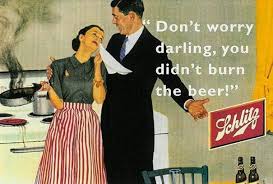 This old advertisement for beer is one that I found that I have mixed feelings about. While it is somewhat humorous and portrays the whole 1950's "everything is pleasant" thing, it also shows the woman to be the inferior servant for her husband, who makes fun of her in the ad. So, even though it is kinda funny, it also angers me a bit.
Summary
In her article "The Sticky Embrace of Beauty", Anne Frances Wysocki attempts to explain to the reader about the way that advertising is pleasing and/or offensive. She argues that the way "beauty" is shown in advertisements may be pleasing to the eye, but the context in which it is being used can be offensive, especially in the way of objectifying women that she talks about in this article.
Synthesis
I honestly can't relate this to much else that we have read, but I do see a similarity between this and the Bernhardt article because both talked about how the visual aspects of a piece of writing (or in this case advertisements) have an effect on the reader.
QD
2. When it comes to the way that Wysocki set up the text in her article, it was low visual, but yet had a few visual elements in it when she was trying to describe the effects of it. I suppose it worked for me, but the one thing that i found really irritating about it was that she used way too many quotes and it distracted me from what the article was about.
3. The Peek ad did catch my attention in a way that was like, "okay, that's definitely a really scandalous looking picture". I can't really say that it interested me or made me want to buy it, but rather it did make me wonder who had the audacity to put that controversial ad out into the mainstream.
AE#2
2. Yes, I do believe that beauty is truly in the eye of the beholder, because everyone's definition of what beautiful is depends on each individual's perception. However, society has set a standard for what the mainstream considers to be "beautiful", and we see this in almost every advertisement for makeup, perfume, hair color, etc. So yes, it is also subjected to some social forces.
MM
This statement applies to Wysocki's article because she explains how the advertising has to catch the eye of the customer and that sometimes it has to go outside the box in order to do so. This applies to other visual art because art oftentimes has to be controversial to catch the viewers attention.
My Thoughts
I honestly did not like this article. I thought it was way too long, and it was so boring I could barely stay awake through the whole thing. It also probably didn't help that I didn't understand most of the article. It was very confusing, mostly because of the way it was worded I suppose.
Summary
In her article "The Sticky Embrace of Beauty", Anne Frances Wysocki attempts to explain to the reader about the way that advertising is pleasing and/or offensive. She argues that the way "beauty" is shown in advertisements may be pleasing to the eye, but the context in which it is being used can be offensive, especially in the way of objectifying women that she talks about in this article.
Synthesis
I honestly can't relate this to much else that we have read, but I do see a similarity between this and the Bernhardt article because both talked about how the visual aspects of a piece of writing (or in this case advertisements) have an effect on the reader.
QD
2. When it comes to the way that Wysocki set up the text in her article, it was low visual, but yet had a few visual elements in it when she was trying to describe the effects of it. I suppose it worked for me, but the one thing that i found really irritating about it was that she used way too many quotes and it distracted me from what the article was about.
3. The Peek ad did catch my attention in a way that was like, "okay, that's definitely a really scandalous looking picture". I can't really say that it interested me or made me want to buy it, but rather it did make me wonder who had the audacity to put that controversial ad out into the mainstream.
AE#2
2. Yes, I do believe that beauty is truly in the eye of the beholder, because everyone's definition of what beautiful is depends on each individual's perception. However, society has set a standard for what the mainstream considers to be "beautiful", and we see this in almost every advertisement for makeup, perfume, hair color, etc. So yes, it is also subjected to some social forces.
MM
This statement applies to Wysocki's article because she explains how the advertising has to catch the eye of the customer and that sometimes it has to go outside the box in order to do so. This applies to other visual art because art oftentimes has to be controversial to catch the viewers attention.
My Thoughts
I honestly did not like this article. I thought it was way too long, and it was so boring I could barely stay awake through the whole thing. It also probably didn't help that I didn't understand most of the article. It was very confusing, mostly because of the way it was worded I suppose.
Thursday, October 4, 2012
Baron Responses #12
Summary
In his article "From Pencils to Pixels: The Stages of Literacy Technologies", Dennis Baron attempts to tell his readers that It is not just computers that are to be considered writing technologies, but that even the simplest things like a pencil are as well. He argues this because when the pencil, typewriter, and the telegraph were invented they also changed the way that people viewed writing in the past, just like computers have changed our views on writing today.
Synthesis
This article relates to the three readings that we read recently about literacy and its "sponsors", as Brandt would say. This relates because the writing technologies described in this article because the way that Baron talks about the writing technologies reminded me of the sponsors of literacy in the Brandt article and how in relation this article describes how the different technologies are the "sponsors" of writing.
Pre-Reading
2. Some technologies that I use for writing are computers, notebooks, pencils and pens. While the computer is certainly more advanced than the others, they all count as technology because they are all serve as a means for me to express something in words.
QD#2
Yes, I do believe that this seems to be one of his messages, and I do agree with the fact that yes, It may be hard to imagine new technologies that change the nature of writing, but it certainly is happening, we see it all around us. Fifty years ago, people would have never imagined typing words that could be seen on a lit up screen, but today, a lot of times you see that happening more than you would see someone writing on paper.
My thoughts
I actually did not mind reading this article, I found it rather interesting. I had never stopped to think about how much the technology that goes into writing has changed over the years, and I also never knew how complicated making a simple thing like a pencil is, so i found it pretty interesting to read about.
In his article "From Pencils to Pixels: The Stages of Literacy Technologies", Dennis Baron attempts to tell his readers that It is not just computers that are to be considered writing technologies, but that even the simplest things like a pencil are as well. He argues this because when the pencil, typewriter, and the telegraph were invented they also changed the way that people viewed writing in the past, just like computers have changed our views on writing today.
Synthesis
This article relates to the three readings that we read recently about literacy and its "sponsors", as Brandt would say. This relates because the writing technologies described in this article because the way that Baron talks about the writing technologies reminded me of the sponsors of literacy in the Brandt article and how in relation this article describes how the different technologies are the "sponsors" of writing.
Pre-Reading
2. Some technologies that I use for writing are computers, notebooks, pencils and pens. While the computer is certainly more advanced than the others, they all count as technology because they are all serve as a means for me to express something in words.
QD#2
Yes, I do believe that this seems to be one of his messages, and I do agree with the fact that yes, It may be hard to imagine new technologies that change the nature of writing, but it certainly is happening, we see it all around us. Fifty years ago, people would have never imagined typing words that could be seen on a lit up screen, but today, a lot of times you see that happening more than you would see someone writing on paper.
My thoughts
I actually did not mind reading this article, I found it rather interesting. I had never stopped to think about how much the technology that goes into writing has changed over the years, and I also never knew how complicated making a simple thing like a pencil is, so i found it pretty interesting to read about.
Subscribe to:
Posts (Atom)